

Some leads convert because teams move fast, personalize, and optimize relentlessly. Responding within five minutes drives up to 400% more conversions; nurtured leads close 50% more often. Segment by fit and intent, score predictively, and route high‑intent prospects instantly. Fix leaks: speed up pages (1‑second loads can triple conversions), A/B test headlines and forms, and use multi‑touch nurturing to shorten cycles 23%. Track conversion velocity and shift budget to top channels. The next steps reveal exactly how.
Key Takeaways
- Conversion hinges on speed-to-lead; respond within 5 minutes to boost qualification and win rates dramatically.
- Segment and score leads by fit and intent to deliver relevant messaging and prioritize high-intent prospects for rapid follow-up.
- Personalize experiences and CTAs across channels; tailored content and predictive analytics significantly lift engagement and conversions.
- Optimize conversion points: fast pages, short forms, A/B-tested offers, and automated routing to the right seller.
- Track conversion velocity and pipeline metrics, iterating nurturing sequences and budget by source performance to turn demand into revenue.
Quick Wins to Lift Lead Conversion Now

Even before new budgets or tech roll out, teams can lift conversions fast by tightening nurturing, scoring, personalization, reengagement, and alignment.
Start with lead segmentation by industry, company size, and source to deliver relevant messaging; personalized CTAs convert 202% better. Use engagement strategies built on behavioral signals: nurtured leads close 50% more often, move 23% faster, and 63% convert later. Deploy marketing automation to generate 451% more qualified leads and run multi-touch programs across email, ads, and social. Buyers increasingly expect near-instant replies—responding to a new lead within 5 minutes can increase qualification chances by 10x. To maximize efficiency, it’s essential to leverage sales funnels for conversion by guiding potential customers through each stage of their buying journey. By optimizing touchpoints within these funnels, businesses can enhance user experience and significantly improve lead nurturing efforts. As a result, you’ll not only track where prospects drop off but also tailor content that resonates, ultimately driving higher engagement and sales outcomes.
Segment smart, personalize CTAs, and automate multi-touch nurturing to accelerate conversions and pipeline quality.
Implement lead scoring using demographics, behavior, and engagement to prioritize pipeline; top performers exceed 30% lead-to-opportunity conversion with strong models.
Don’t send the 61% of unscored leads to sales; automate routing so only qualified prospects advance. Reengage with retargeting—147% higher conversion rates—using dynamic content, time-sensitive offers, and drip sequences; many wins land on the 2nd to 5th follow-up.
Align sales and marketing with metric-driven SLAs and shared CRM data to shorten cycles and drive revenue.
Speed to Lead: Convert 9x More With Fast Response

Five minutes can make or break a deal: responding within 5 minutes drives up to 400% higher conversions and makes leads 100x more likely to qualify than waiting 30 minutes. Speed to lead compresses response time to where intent is hottest, boosting both conversion and lead qualification. A 1-minute response can yield 391% higher conversions; every 10-minute delay slashes chances by 400%. After one hour, the likelihood of contact drops 10x and 78% of buyers choose the first responder—yet the average response time is 42 hours. Fast response times lead to higher overall conversion rates, meaning that improving speed-to-lead directly maximizes marketing ROI. Implementing effective timing strategies for lead conversion can further enhance the impact of rapid response tactics. By analyzing patterns in lead engagement, businesses can optimize follow-up timing to align with peak interest periods. This tailored approach not only increases the likelihood of engagement but also fosters stronger relationships with potential customers.
| Window | Conversion Impact | Lead Qualification |
|---|---|---|
| 1 minute | +391% conversions | Highest likelihood |
| 5 minutes | +400% conversions | 100x more likely |
| 10 minutes | 8x drop vs instant | Qualification plunges |
| 60 minutes | 10x harder to connect | 7x–60x better than 24h |
| 24 hours | Massive decay | Near-zero momentum |
Actions: route inbound instantly, trigger SMS/call in under 60 seconds, staff coverage beyond business hours, and track first response time as a primary KPI to protect revenue at the point of intent.
Lead Conversion Benchmarks by Industry and Channel

Speed wins the first click; benchmarks show where to aim next. Industry benchmarks clarify what “good” looks like and where lead conversion lags. the importance of lead followup strategies cannot be underestimated in this process. A timely and relevant follow-up can significantly enhance the likelihood of conversion, turning potential opportunities into loyal customers. By refining these strategies, businesses can improve their overall sales performance and maintain a competitive edge in the market. monetizing leads through effective strategies is essential for maximizing the return on marketing investments. By employing data-driven techniques and personalized outreach, companies can not only increase their conversion rates but also build stronger relationships with their clientele. Ultimately, focusing on these innovative approaches will pave the way for sustained growth and profitability.
Lead-to-MQL rates range widely: Biotech 42%, Cybersecurity 39%, Aerospace & Defense 34%, eCommerce 23%, Construction 17%. Set targets by vertical, not vanity. The average lead-to-MQL conversion rate across industries is 31%, offering a baseline to gauge whether your lead quality and channels are performing above or below norm.
Sales call conversion varies, too: Janitorial Services and Printing exceed 26%, Security Systems 18.15%, Logistics 17.86%, while Industrial Equipment falls below 9%. If you’re under peer medians, diagnose qualification and talk tracks.
Channel benchmarks guide budget. All-industry averages: Paid Search 3.2% outperforms Direct and Referral at 2.9%, Organic Search 2.7%, Email 2.6%.
For landing pages, Product and White Paper pages convert at 38%, Services at 33%, Locations 25%, Hubs 20%—match intent to page type.
Calibrate expectations: median conversion across industries is 6.6%; B2B averages 2–5%, B2C online under 2%. Google Ads averages 7.52%.
Pipeline math matters: lead-to-opportunity averages 12%.
Fix Leaks to Improve Lead Conversion: Pages, Forms, Follow-Up

Plug conversion leaks where they occur most: pages, forms, and follow-up.
Start with page design and speed. One-second loads triple conversion vs. five seconds, and sites loading in one second convert 5x better than 10-second loads. Pair speed with A/B testing to lift conversions ~12%. Aim to beat the 2.9% average; lead-gen landing pages already reach 11.9%. Standardized lead definitions between Marketing and Sales reduce friction and improve conversion by ensuring only quality leads progress through the funnel. By measuring lead generation effectiveness, businesses can identify which strategies yield the highest returns. This approach not only enhances overall performance but also supports data-driven decision-making. Ultimately, refining these methods can lead to increased revenue and sustainable growth.
Personalize: tailored experiences lift conversions 212%, and predictive analytics surfaces patterns to refine engagement tactics.
Tighten form optimization. Fully gated videos and adding the word “email” in copy reliably boost capture rates, often doubling results. Benchmark by vertical—professional services forms average 5.2%, home improvement quotes 4.0%—and iterate to exceed the 1.4% SMB visitor-to-lead norm.
Accelerate follow up strategies. Respond fast to protect momentum over the 64.5-day average cycle.
Use AI lead scoring to convert 28% faster and apply closed-loop feedback to sharpen targeting. Data-driven sequences reduce conversion time by 30%.
Nurture Leads to Win Long Cycles Without Losing Momentum

To sustain momentum in long cycles, the team executes timely, multi-channel follow-up—email, ads, and sales touchpoints—knowing nurtured leads see a 23% shorter sales cycle and up to 10x email response rates. Only 16% of B2B marketers rate their lead nurturing efforts as excellent, highlighting significant room for improvement. They personalize messaging and cadence by segment and behavior, since targeted content is the top lever and stage alignment can lift conversions by 72%. With lead scoring and automated triggers, they orchestrate stage-based nurturing that boosts sales opportunities by up to 20% while protecting ROI. They continuously evaluate payperlead marketing efficiency metrics to optimize their strategies further. This data-driven approach allows them to identify which channels generate the highest ROI, ensuring that each marketing dollar is spent effectively. Additionally, by refining their lead generation tactics, they aim to enhance overall customer engagement and satisfaction.
Timely, Multi-Channel Follow-Up
While interest is highest right after a hand-raise, sustained wins come from fast, persistent, multi-channel follow-up.
Teams that apply timing strategies connect 100x more by responding within five minutes; within an hour, they get 7x more conversations. Next-day drops response 11%, yet a three-day touch can lift replies 31%; after five days, odds fall to 24%.
Use channel synergy: 3+ touchpoints lift MQL-to-SQL 28%, and three or more channels drive 287% higher purchase rates. Combine calls, email, and LinkedIn for 28–37% conversion gains; LinkedIn DMs respond at 10.3% vs. email’s 5.1%, while post-contact text boosts engagement 112.6%.
Persist: at least five attempts—most wins land by attempt six. Sequence 16 touches over 2–4 weeks, interleaving emails between calls for +16% contact.
Personalized, Stage-Based Nurturing
Because long sales cycles stall without relevance, personalized, stage-based nurturing maps content and outreach to where each lead sits—driving 72% higher conversions with precise content-to-stage alignment.
It starts with awareness: educational reports and trend analysis in an informative tone, no sales pressure. As interest grows, stage specific content shifts to solution comparisons and case studies; decision stage adds high-touch offers, incentives, and sales engagement.
Lead scores steer personalized outreach: low scores get longer educational sequences, medium scores receive mixed channels, high scores trigger personal follow-up. Automation scales it, using real-time signals and AI to optimize. When focusing on ways to revive cold leads, it’s essential to implement targeted email campaigns that resonate with their past interests. Additionally, leveraging social media engagement can reignite conversations and foster a more personalized approach to rekindling those connections. Ultimately, a consistent follow-up strategy will reinforce your commitment to understanding their needs and reviving interest.
- Segment by behavior, demographics, and intent; trigger dynamic content
- Use predictive scoring to prioritize next best action
- Orchestrate multi-channel sequences with branching logic
- Track CTRs, attendance, opportunities, and MQL-to-SQL to iterate
Score, Segment, and Route Leads at the Right Time

Even before a rep picks up the phone, winning teams score, segment, and route every lead with precision so high-intent prospects reach the right seller in minutes.
Before reps call, top teams score, segment, and route leads so high-intent buyers reach the right seller fast
They run score optimization and segment analysis to combine fit grades with activity thresholds—e.g., >60 triggers assignment—so urgency is unmistakable. Alerts fire at key thresholds, pushing timely follow-ups that lift conversion; organizations using prioritized scoring report a 77% ROI increase in lead gen.
Segment by geography, company size, product interest, and lead source. Tailor models for enterprise vs. SMB; route SMB to volume teams and enterprise to senior reps.
Use demographics and firmographics aligned to the ICP, and apply product-specific category scores to direct experts.
Automate with Salesforce Assignment Rules, HubSpot Workflows, or LeanData/Chili Piper for round-robin, territory, and calendar routing. Enforce SLAs—15 minutes for high-intent—fast-track top scores to strategic reps, and monitor intent spikes.
Review scores quarterly and audit reassignments and SLA adherence monthly.
Map Your Lead Funnel From Demand to Revenue
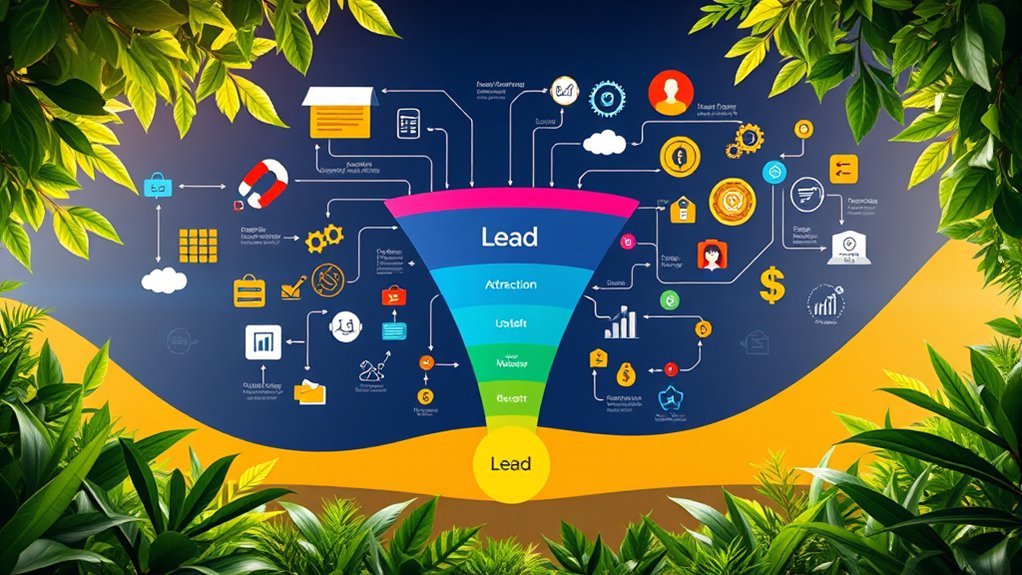
How can teams turn raw demand into predictable revenue? They should map a lead funnel that connects demand generation to ARR targets. Start by defining stages: Awareness (campaigns and content), Interest (education), Consideration (tailored solutions), Evaluation (comparisons), and Decision (purchase or demo). One effective approach is turning demand into sales strategies that resonate with the target audience. By aligning marketing efforts with the defined stages of the lead funnel, teams can create a seamless transition from awareness to purchase. This alignment not only enhances the customer journey but also optimizes conversion rates across different channels.
Then align to revenue math: confirm ARR target, win rate, ACV, and required marketing-sourced pipeline. Specify ICP and buying groups—finance, compliance, IT, technical, end users—and decide self-serve vs. seller-assisted paths by buyer type. Lock SLAs, routing, and MQL/SQL/SQO criteria so handoffs don’t leak.
- Quantify volume: monthly lead generation rate, source performance, target-account traffic, cost per lead.
- Monitor quality: lead-to-MQL and lead-to-opportunity rates, scoring accuracy, source quality.
- Measure velocity: time in stage, progression rates, total duration, sales cycle length.
- Calibrate capacity: SDR/AE bandwidth by stage to meet pipeline goals.
This map turns demand into stage-by-stage accountability, predictable conversion, and revenue.
Measure What Matters: Lead Conversion Metrics and A/B Tests

While flashy top-of-funnel volume tempts teams to celebrate early, performance hinges on a tight set of conversion metrics and disciplined A/B tests that move buyers faster. Track conversion velocity from MQL to SQL to closed won, plus MQL→SQL and lead-to-customer rates.
Measure what matters: conversion velocity, MQL→SQL movement, and lead-to-customer rates—not vanity volume.
Calculate pipeline velocity as (opportunities × average deal size × conversion rate) ÷ sales cycle; compute average deal size from total revenue ÷ closed deals. Benchmark against B2B norms: site conversions average 2.23% (professional services 5–6%), overall funnels hit 3–5%, and time-to-customer averages 64.5 days.
Prioritize lead quality indicators: average lead value and a lead quality score by source. With 79% of leads never converting, lead scoring and nurturing matter—implementation cuts acquisition cost 45% and speeds conversions 28%. In addition to evaluating lead quality indicators, businesses should also focus on implementing lead generation best practices for businesses that emphasize targeted content marketing and personalized outreach. Leveraging data analytics can provide insights into customer behavior, enabling companies to refine their strategies further. By integrating these practices, organizations can increase their chances of attracting high-quality leads that are more likely to convert.
Run relentless conversion optimization: A/B test headlines, offers, forms; segment by page/source in GA4 or HubSpot. Shift budget when free trials convert 10% vs. 2% downloads.
Deploy interactive content (2x conversions) and AI chatbots (64% more qualified leads, up to 20% higher rates).
Frequently Asked Questions
How Do Privacy Regulations Impact Lead Conversion Strategies Across Regions?
Privacy regulations reshape lead conversion strategies via privacy compliance and regional differences. He prioritizes zero‑party data, progressive profiling, GPC enforcement, and consent mode v2. He localizes consent flows, trims fields, personalizes CTAs, audits vendors, and discloses AI—boosting conversions and reducing risk. Understanding the impact of attribution models on revenue is crucial for maximizing the effectiveness of these strategies. By leveraging data insights, businesses can adapt their marketing efforts and allocate resources more efficiently. This approach not only enhances conversion rates but also fosters long-term customer relationships.
What Roles Should Sales and Marketing Play in Lead Handoffs?
Sales defines SAL criteria with marketing, codifies SLAs, and executes fast follow-up; marketing drives lead nurturing, scoring, and detailed context. Both enforce communication alignment via bi-weekly feedback, track MQL→SAL rates, response times, and pipeline velocity, iterating qualification for higher conversion.
How Do You Budget for Lead Conversion Technology and Tools?
They budget 8–10% for conversion tools within lead budgeting, prioritize email, SEO/content, and chatbots, reserve 5–10% for R&D, allocate 25–30% of paid budgets to creative testing, train teams, and reallocate 10–15% weekly using marginal CPL thresholds.
Which Data Governance Practices Protect Lead Quality and Compliance?
They enforce data stewardship, codify quality standards, and automate validation to protect lead quality and compliance. They monitor data accuracy KPIs, audit trails, and consent, then refine lead segmentation via feedback loops, ensuring compliant pipelines, higher conversion, and actionable insights at scale.
How Do Seasonality and Macroeconomics Affect Conversion Forecasts?
Seasonality and macroeconomics reshape conversion forecasts: seasonal trends drive spikes or slumps, while economic fluctuations depress inbound leads. He benchmarks variance, models demand periods, segments PPC, time-limits offers, and scales budgets, yielding higher ROI, steadier pipelines, and resilient, conversion-focused forecasts.
Conclusion
In the end, teams that act fast, measure what matters, and fix friction convert more leads into revenue. They respond within minutes, benchmark by channel, and plug leaks on pages, forms, and follow-up. They nurture long-cycle deals without dropping velocity, and they score, segment, and route at the right moment. They map the funnel from first touch to closed-won and A/B test relentlessly. The data’s clear: operational discipline turns demand into predictable, compounding revenue growth.