

Vertical-specific lead generation aligns tactics to buyer behavior and unit economics. Government converts at 4.92% with 64.5-day cycles; ecommerce hits the lowest CPL at $91, while higher ed pays $982. Content, ABM, CRM, and forms power predictable pipeline—LinkedIn drives 80% of B2B leads; 68% use strategic landing pages; webinars lower tech CPL and nurture healthcare MQL-to-SQL at 15–25%. Real estate wins with virtual tours; finance with multi-step forms; education with role-based pages—there’s a clear playbook ahead.
Key Takeaways
- Healthcare: HIPAA-safe webinars and nurture emails score engagement, track MQL-to-SQL (15–25%), and use polls/chat to lift webinar interaction by 22%.
- Real estate: Social ads, virtual tours, and Zillow traffic feed high-intent leads; multi-step forms boost conversions up to 300% with automated drips.
- Financial services: Multi-step forms, segmentation, and predictive scoring improve 1.7% average conversion; track lead-to-appointment-to-client progression rigorously.
- Technology: ABM with intent data, demo-driven qualification, and webinars lower CPL versus PPC; multi-channel orchestration lifts engagement by 20%.
- Education: Role-based pages and newsletters drive 3x more leads than outbound; email dominates with 28.5% open rates and strong under-35 interest.
Lead Generation by Industry: What Works at a Glance

Although performance varies widely by vertical, the data makes priorities clear at a glance: government administration leads with a 4.92% conversion rate but requires patience with 64.5-day cycles; banking and manufacturing lag at 1.52%, alongside apparel (1.93%), luxury (1.9%), and computer games (1.95%).
These industry benchmarks frame lead trends and guide conversion strategies. Public relations (4.66%), mining and metals (4.62%), and non-profit management (4.62%) also convert strongly, suggesting trust-driven value propositions and longer nurturing. Additionally, 87% of B2B marketers successfully use content marketing to generate leads, underscoring the need for targeted assets aligned to each vertical’s buying cycle. As firms navigate these dynamics, identifying lead generation strategies for tech firms becomes increasingly critical. The implementation of innovative digital marketing techniques can significantly enhance their outreach efforts. By leveraging data analytics and targeted campaigns, tech companies can better connect with potential clients and drive measurable growth.
Cost analysis shifts priorities: higher education tops CPL at $982, followed by financial services ($653), legal ($649), oil and gas ($637), and software development ($591).
Ecommerce sets the low-cost floor at $91 and enjoys B2C scale—196.5 new leads monthly, near 10% landing page submission rates, and strong social acquisition with 66% of marketers active.
In B2B software, LinkedIn dominates: 89% use it; 80% of leads originate there; 62% see 2x rates. Referrals contribute 33% of top-quality leads.
B2B Tactics That Work Everywhere (Content, ABM, CRM, Forms)

Momentum comes from disciplined basics: content, ABM, CRM, and forms working as one system. A data-driven content strategy fuels audience engagement and pipeline: 87% of B2B marketers generate leads with content, and it produces 3x more leads than outbound at 62% lower cost.
Momentum comes from disciplined basics: content, ABM, CRM, and forms working as one system.
Strategic landing pages—used by 68%—plus personalized post-click paths lift conversion, while 78% use content to nurture across the journey. Quality beats volume: 52% prioritize fit and engagement depth. LinkedIn dominates B2B lead gen, with 80% of B2B leads originating there, making it essential to pair with content and ABM for decision-maker reach.
ABM scales precision. Predictive outbound taps hiring or funding signals, while multi-channel programs combine SEO, paid search, LinkedIn, and email to meet intent.
Website intelligence de-anonymizes target accounts; dynamic, signal-layered scoring surfaces buying committees early. Micro-events like 10-person roundtables yield sales-ready conversations.
In CRM, automation powers speed-to-lead with instant alerts and calendar links. Enforced lifecycle definitions focus sales on MQL-to-SQL progression.
Standardized forms, gated assets, and ROI tools boost completion rates; scoring inside gated content enables immediate routing and clean segmentation.
Healthcare Lead Generation: Webinars, CRM Nurtures, HIPAA-Safe Email

Healthcare programs convert when educational webinars carry clinical evidence and ROI data, earning 15–30 behavioral points and moving HCPs through an omnichannel path.
Teams should pair these events with HIPAA-compliant email nurtures—encrypted, logged, and BAA-backed—that trigger 20–30 points for compliance asset downloads and personalize outreach from current buying data. In independent evaluations, agencies with strong healthcare expertise and thought leadership achieved the highest rankings for lead generation effectiveness.
Strategically, marketers track MQL-to-SQL progression, lead-to-opportunity rates of 15–25%, and webinar-to-email sequences over 12–24 months to optimize conversion.
Educational Webinars That Convert
When planned around clinician-grade content and integrated with CRM-driven nurture, educational webinars become a top-performing healthcare lead engine.
Teams prioritize webinar engagement strategies while addressing healthcare compliance challenges by selecting respected clinicians and medically accurate speakers, plus executives for operational topics. To maintain trust and avoid risk, webinars must use HIPAA-compliant platforms and processes, including encrypted registration and no PHI in Q&A.
High-performing topics include CMS regulation updates, evidence-based protocols, revenue cycle optimization, emerging therapies, and real-world evidence case studies.
Polls and chat lift engagement 22%, while detailed registrations enable precise segmentation and behavioral scoring (e.g., 15 points for outcome-webinar attendance).
During sessions, 25% CTA click-through rates are common; 47% of attendees become leads, with 5–20% converting to clients.
Product demo webinars with warm leads convert at 20–30%, driving 15–25% lead-to-opportunity rates.
Integrated with CRM and amplified via LinkedIn and medical portals, webinars rank among top-of-funnel leaders.
HIPAA-Compliant Email Nurtures
Although regulations add complexity, HIPAA‑compliant email nurtures can scale qualified demand by pairing secure infrastructure with precise segmentation and measurement. In healthcare marketing, teams should measure both monetary returns and non-financial benefits like patient engagement, satisfaction, and adherence to fully understand ROI. Teams should use platforms with HIPAA compliance, email encryption, secure storage, access controls, audit logs, and integrity safeguards. They must obtain patient consent, avoid unencrypted PHI, and run routine risk assessments.
Audience segmentation by condition, demographics, or preferences powers relevance without exposing PHI. Educational content, clear opt‑in/opt‑out, and BCC for bulk sends reduce misdelivery—an 8% breach driver.
Measure engagement metrics: open rates averaging 41.2%, CTR, conversions (appointments, downloads), and unsubscribes to optimize A/B tests.
Breach prevention is critical as hacking dominates incidents; encrypt in transit and at rest. Done right, email delivers 122% ROI, preferred by 72% of clients and mostly mobile.
Real Estate Lead Generation: Social Ads, Virtual Tours, High-Converting Forms

Even in crowded markets, real estate teams can scale predictable pipeline by pairing social ads, immersive virtual tours, and high-converting forms into one cohesive funnel.
They start with geo-precision: Zillow Premier Agent captures intent-rich traffic from 230M+ monthly views, while CINC targets micro-niches like neighborhoods and school districts. With 65.9% using organic social and 53.7% PPC, retargeting pixels re-engage visitors, and cash-offer ads or Google Local Service Ads pull in seller demand.
Virtual tours do more than showcase listings; galleries of past work and local attractions signal marketing strength. Since 43% begin online and 69% browse on mobile, IDX search and neighborhood landing pages gate detailed data, while AI-personalized videos lift engagement.
High converting forms drive capture: multi-step WordPress flows boost conversions up to 300%, guides trade value for emails, and live chat accelerates qualification.
Lead nurturing uses automated drips, predictive scoring, and micro-farm targeting. Performance metrics track lead-to-appointment-to-client, benchmarking against the sector’s 1.7% conversion rate.
Finance Lead Generation: Multi-Step Forms, Segmentation, Intent Data
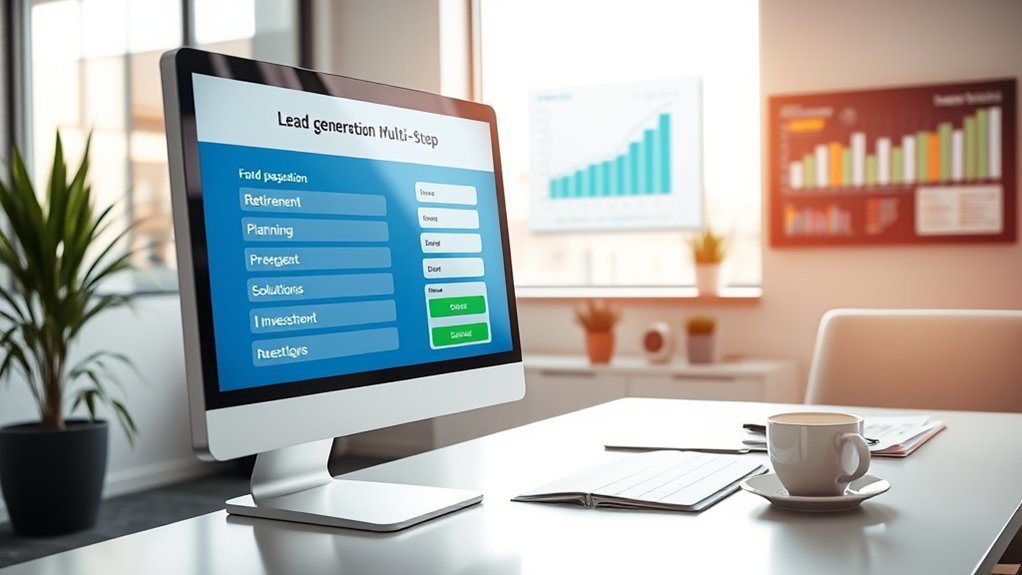
Real estate teams optimize funnels with social proof and forms; finance firms win by engineering capture around multi-step forms, precise segmentation, and intent signals.
They deploy multi-step forms to reduce abandonment, qualifying by investment goals, income, and timelines across stages. Progressive profiling boosts completion 30–50% for advisors, while gated tax or retirement guides trade value for richer data.
CRM integration turns responses into automated lead scoring and fast routing.
CRM integration transforms responses into automated scoring, instant routing, and faster advisor follow-up.
Segmentation follows: enriched profiles split prospects by net worth, career stage, and goals. Historical cohorts highlight high-ROI niches like executives or founders.
Drip tracks expressed interests—retirement vs. tax strategies—to lift opens, and relationship intelligence targets warm introductions via shared affiliations. Shared sales–marketing definitions clarify warm thresholds and handoffs.
Intent data sharpens prioritization. SEO and LinkedIn signals (keywords, job changes) surface high-readiness segments; event lists get vetted for fit.
Personalized emails reference professional goals, raising CTRs. Prospect nurturing sustains trust via welcomes, re-engagement, newsletters, and education—until intent peaks.
Technology Lead Generation: ABM, Demos, Video, Webinar Capture

Technology leaders prioritize ABM personalization at scale, using first-party intent and AI agents to target high-value accounts and cut speed-to-lead from hours to seconds.
They turn interest into demo-driven lead qualification with interactive experiences that double conversions and feed CRM for fast routing.
They capture demand with video and webinars across LinkedIn and owned sites, using automation to personalize follow-up and convert registrations into Sales-Accepted Leads.
ABM Personalization At Scale
While many teams still spray-and-pray, high-performing programs treat ABM personalization as an engineered system that scales. They anchor personalization strategies in data driven insights: intent signals, predictive scores, and channel performance.
Personalized ABM assets lift opens 29% and clicks 3.1x, while personalized messaging drives 20% higher engagement. On-site personalization adds 18–34% more demo requests, and hyper-personalization is now used by 80% of B2B companies.
To scale, leaders deploy AI to 5x content output and reach 85% of target accounts via automation. Real-time intent data—used by 72% of programs—shortens cycles 15%.
Multi-channel orchestration, adopted by 80%, boosts engagement 20% with sequences spanning email, LinkedIn, and SDR calling. Account-based webinars earn 2.7x attendance; live roundtables convert 22% to meetings.
Coordinated campaigns improve engagement for 73%.
Demo-Driven Lead Qualification
Because funnel efficiency hinges on intent, demo-driven lead qualification (DQL) makes the demo the gate to progression—turning product interaction into proof of readiness. It replaces soft signals with demo engagement as the decisive filter, surfacing genuine buyer intent and conserving sales capacity.
With traditional models converting only 10% to qualified and 1–6% to customers, DQL counters systemic waste: eight in ten failed conversations stem from poor qualification.
Practically, teams score engagement recency and frequency, weighting actions like scheduling, attending, asking use-case questions, and completing follow-ups.
Problem awareness and urgency become the primary criteria; attendance and post-demo momentum validate both. Predictive scoring flags patterns aligned to closed-won. Operate within the 41–60 scoring band while nurturing outliers.
Combined models outperform single-factor scoring and prevent intent–interest confusion.
Video And Webinar Capture
A well-run webinar is a lead magnet and a qualification engine in one. For technology ABM, it consistently outperforms alternatives: webinars deliver a $72 CPL, 40–70% lower than PPC and far below trade shows ($811), with B2B ROI near 1,200%.
They also scale: mid-market events capture 500–1,000 leads, 20–40% qualify, and 5–20% convert to customers. Live sessions drive 89% of leads and convert 2x more than on-demand; multi-session series generate 2.3x more leads. Strong video engagement and audience retention hinge on precise orchestration.
1) Drive registration: LinkedIn converts 57% higher; video promo ads add 34%; clear CTAs lift 28%.
2) Convert in-session: case studies convert 41% higher; offers in final 10 minutes win.
3) Accelerate pipeline: 62% request demos; webinar leads convert 22% faster.
Education Lead Generation: Role-Based Pages, Newsletters, Journey Fit

Blueprints matter: in education lead gen, role-based pages, newsletters, and journey-fit metrics align spend to enrollment value, not inquiry volume.
Role based optimization starts with pages for decisive, ROI-driven segments: leadership-track learners convert at 15.73% and career changers at 9.75%. First-party data reveals adult learners under 35 show 2x interest, while Gen Z will be 60% of adult learners by 2031—target them with outcomes, salary lift, and time-to-completion.
Newsletter strategies carry the nurture load. Email is the top channel for 48% of marketers, with education open rates at 28.5%. Newsletters generate 3x more leads than outbound and influence 44% of purchases, delivering high-intent at lower cost than ads.
Journey fit reframes unit economics: with higher-ed CPL averaging $982, teams prioritize cost per application and enrolled value.
AI models identify prospects pre-form, while stealth applicants reach 9.7%. Structure content for AI Overviews and conversational search to capture the 79% who read them.
Choose Your Industry Stack: CRM, Email, Forms, Ads, and Automation Picks

Email nurtures and journey-fit metrics only work if the stack captures, scores, and routes intent without friction. Teams should align CRM integration strategies with channel signals, then select Email automation tools that react to behavior, not blasts.
Salesforce lead scoring, HubSpot’s free forms, and Pipedrive’s stage logic set the data spine; Zoho and Monday.com extend multi-channel import and ABM segmentation.
Salesforce scoring, HubSpot forms, and Pipedrive stages build the spine; Zoho and Monday.com expand ABM reach.
- 1) Forms: Apply Form design principles with Typeform’s conversational flows, Jotform’s conditional logic, and Unbounce’s mobile A/B tests to reduce drop-off and tag UTM-validated sources in the CRM.
- 2) Ads: Use Ad targeting techniques via LinkedIn titles/companies, Google intent + remarketing lists, and Facebook lookalikes piped from CRM audiences to raise SQL rate, not just CTR.
- 3) Automation: Drive Automation workflow efficiency by linking Zapier, Intercom, and Drift to qualify and route; let Marketo orchestrate ABM, while Cognism’s intent ranks outreach priority.
Close the loop: trigger ActiveCampaign or Mailchimp drips, Klaviyo re-engagement, ConvertKit webinars, and Sendinblue SMS for timely follow-ups.
Frequently Asked Questions
How Do We Measure ROI Across Different Industry-Specific Funnels Consistently?
They standardize ROI by unifying TOFU-MOFU-BOFU KPIs, normalizing costs, and tying CLTV to attribution. They centralize lead tracking via CRM/BI, apply custom weighted models, benchmark per vertical, and iterate funnel optimization using ROAS, incremental lift, and cohort retention.
What Compliance Considerations Differ Internationally for Vertical Lead Data?
They differ by sectoral scope, lawful-basis thresholds, localization rules, and breach reporting. Teams align to international regulations, prioritize data privacy, tighten consent management, validate cross border compliance, respect cultural differences in outreach, and anticipate enforcement challenges with audits, SCCs, and vendor due diligence.
How Should We Staff Teams for Verticalized Lead Gen Operations?
They should staff by vertical pods with clear team structure and role specialization: vertical strategists, compliance-savvy SDRs, technical SMEs, marketing partners, and analysts. They’ll align KPIs, configure CRM by industry, and resource to cyclical demand patterns.
Which KPIS Forecast Pipeline Health Before Conversions Occur?
They should track lead response time, funnel velocity, pipeline velocity, lead score trends, MQL creation rate, source quality, contact rate, and meeting booking rate. Predictive analytics flags deterioration before conversion rates dip, spotlighting stuck stages and channel underperformance early.
How Do We Budget and Allocate Spend Between Verticals Quarterly?
They set vertical budget allocation quarterly using 60/30/10 for new campaigns, tiered by risk and CPL. They shift 20-30% by performance, keep 85-95% direct response, maintain foundation channels at 50-60%, and execute monthly 10-15% quarterly spending strategies adjustments.
Conclusion
Vertical lead gen isn’t guesswork—it’s a playbook. Each industry demands its own mix: healthcare thrives on HIPAA-safe nurtures and webinars; real estate converts with social ads and virtual tours; finance wins with multi-step forms and intent data; tech scales with ABM, demos, and video; education advances with role-based journeys and newsletters. The common thread is rigorous CRM hygiene, segmentation, and testing. Teams should pick a stack, define metrics, and iterate weekly to shorten cycles and lift qualified pipeline.