

In 2026, a valuable lead equals proven revenue potential: tight ICP fit, urgent intent, and BANT-qualified readiness. Teams price and prioritize using LTV × conversion rate × margin, pipeline velocity, and lead quality scores. Quality beats volume—20–30% conversion vs ~3%—while urgent buyers cut cycles from four months to six weeks. Nurtured leads are 47% more likely to buy, reducing SDR burnout and forecast noise. If they want the playbooks, metrics, and scoring weights that make this repeatable, they’re in the right place.
Key Takeaways
- Valuable leads match ICP firmographics, roles, and urgent pain signals, showing readiness through intent data and short implementation timelines.
- Quality beats volume: high-quality leads convert at 20–30% vs. ~3% for low-quality, boosting win rates and forecast accuracy.
- Use BANT to price and prioritize: budget-ROI fit, decision authority, validated need, and near-term timeline increase conversion probability.
- Measure value via LTV × conversion rate × margin, and track pipeline velocity to link lead quality to revenue speed.
- Behavioral and intent signals—repeat visits, solution keywords, competitor triggers—predict purchase intent; prioritize fast follow-up.
Lead Value in 2026: Definition, Formula, TL;DR

Even as pipelines grow, lead value in 2026 hinges on revenue impact, not raw volume. It’s defined by revenue potential from a single lead, grounded in conversion likelihood and long term profitability. High-value leads mirror the ideal customer and show intent signals—location, urgency, service readiness—making precision targeting and AI personalization essential. Measure success based on conversion quality and revenue impact to avoid vanity metrics and wasted spend. In this landscape, adopting highintent demand generation strategies will be crucial for identifying and nurturing these high-value leads. By leveraging data analytics and customer insights, businesses can better understand their audiences and refine their targeting efforts. Ultimately, this approach will lead to more effective marketing campaigns that not only drive engagement but also maximize revenue growth.
Lead value is revenue-first: target intent-rich, ideal-fit prospects with precision and AI personalization
Here’s the formula view:
Average Lead Value = total revenue / total leads.
Layer in CLTV (average purchase value × purchases per year × customer lifespan) and track conversion rate (customers ÷ leads).
Add Sales Pipeline Velocity: (opportunities × average deal size × conversion rate) ÷ sales cycle length.
Pair with a Lead Quality Score that weights source and actual conversion performance.
TL;DR: Quality fuels revenue.
Prioritize leads that convert faster, carry higher LTV, and reduce CPA.
Monitor revenue per lead, lead-to-customer conversion, and sales cycle length.
In 2026, precision targeting outperforms spray-and-pray—quality-first programs already revealed a $312M pipeline.
Average Lead Value and Pricing in Performance-Based Gen

To set a baseline, he calculates average lead value from LTV x conversion rate x margin, then benchmarks against 2026 CPL ranges (e.g., SaaS MQL $40–$100, BANT $150–$400; webinars ~$72; events ~$811–$881). This approach ensures spend is tied to measurable outcomes by leveraging performance-based spend to eliminate waste and maximize ROI. He aligns pricing to quality by using tiered models—MQL vs. BANT, seniority/intent bands, and channel-adjusted floors—so per-lead fees map to expected revenue (e.g., enterprise B2B $200–$1,000, consumer verticals $2,000–$3,200). He weights BANT factors (budget, authority, need, timing) to score leads and sets premiums or discounts accordingly, with caps tied to acceptable CAC and payback targets.
Defining Average Lead Value
While marketers often obsess over cost per lead (CPL), average lead value is the metric that grounds pricing in performance: it quantifies what an average lead is worth based on conversion rates and downstream revenue, not just acquisition cost. By 2026, AI-enabled lead scoring and real-time verification will further refine average lead value estimates by improving lead quality signals at the point of acquisition.
In lead generation, he should start with CPL (spend ÷ leads) to benchmark efficiency—e.g., $10,000 ÷ 200 = $50 CPL—then multiply by stage-to-close rates and expected deal value to estimate average lead value.
Calibrate by industry norms: B2B MQLs often range $35–$140, while BANT leads reach $150–$600; enterprise SaaS averages ~$237 CPL, real estate ~$448.
Adjust for market saturation, geography, and qualification criteria. Validate with LTV:CAC. If average lead value doesn’t exceed CPL plus sales costs, scale back; if it does, press budget into the best-performing channels.
Quality-Based Pricing Models
Because not every lead contributes equal revenue, quality-based pricing ties what a buyer pays to the signals that predict conversion and deal size.
Teams blend pricing strategies with lead qualification to align cost with expected ROI. Tiered pricing sets premiums for high-intent actions (demo/pricing requests) and discounts for marginal leads, while pay-per-lead offers predictability across sources. In 2026, leading teams also price against SAL velocity, aligning cost to how quickly qualified intent converts to Sales-Accepted Leads.
CPA and CPO shift risk toward vendors by charging only on closed customers or accepted opportunities. Dynamic pricing flexes with market supply, geography, and industry norms—under $100 per lead in e-commerce, near $1,000 in higher ed, and far higher when LTV tops $50,000 in B2B tech.
Progressive qualification and sales feedback refine signals—intent depth, firmographic/technographic fit, SAL velocity, and buying-group depth—to price what truly converts.
BANT-Driven Valuation Factors
Even as pricing models get smarter, BANT remains the backbone for valuing leads in performance-based generation because it ties price to conversion probability and deal size. It continues to align sales and marketing around predictable growth by prioritizing who can buy, why they would buy, and when they are likely to buy, reinforcing its role as a proven framework.
Teams use BANT criteria to quantify average lead value, align lead prioritization, and set tiered payouts by score bands.
- Budget: Apply predictive financial assessment to verify funding stage (approved, estimated, exploratory). Weight higher in mid‑market; raise price when capacity and willingness match offering costs.
- Authority: Map economic buyers and influencers to capture decision making dynamics. Heavily weight in enterprise; price premiums for confirmed authority paths.
- Need: Run pain point analysis against ICP fit; prioritize severity and impact of inaction to inform sales strategies and CPL floors.
- Timeline: Conduct urgency evaluation from business triggers; forecast by tracking days to qualification.
Outcome: better conversion, tighter forecasting, smarter resource allocation.
Lead Quality vs. Volume: What Actually Drives Revenue

In 2026, revenue follows quality: predictive scoring lifts conversion to 6% (vs. 3.2%), close rates jump to 20–30%, and sales cycles compress from four months to six weeks.
He should track revenue per lead, CPA for qualified leads, and LTV to prove a quality-first model, then operationalize with BANT, ICP firmographics, ABM, and real-time intent.
Meanwhile, volume’s hidden costs—SDR burnout, pipeline pollution, and lower win rates—inflate activity without outcomes and erode forecasting accuracy.
Quality-First Revenue Impact
While larger pipelines feel safer, revenue actually accelerates when teams prioritize lead quality over volume. The data’s blunt: high-quality leads convert at 20–30% vs. 3% for bulk lists. Organic and SEO-driven opportunities close at 14.6% compared to 1.7% for outbound, and referred leads convert 3–5× higher. That’s revenue alignment grounded in quality metrics, not guesswork. Implementing inbound marketing strategies for businesses not only enhances lead quality but also fosters stronger relationships with potential customers. By focusing on valuable content and customer engagement, businesses can effectively nurture leads through the sales funnel. This approach ultimately leads to more sustainable revenue growth and a loyal customer base.
- Conversion lift: Nurtured leads are 47% more likely to buy; 100 quality leads at 25% rival 1,000 low-quality at 3%.
- Faster cash: Urgent, problem-aware buyers cut cycles from four months to six weeks.
- Predictable forecasts: Qualified prospects multiply close rates and stabilize projections.
- Better LTV and cost: Referrals carry 16% higher lifetime value; nurturing yields 50% more sales-ready leads at 33% lower CPL.
Volume’s Hidden Costs
Though bigger lists look impressive on dashboards, the math exposes their drag on revenue. With average CPL doubling to $400 since 2017 and a blended $391.8, unchecked volume creates costly lead saturation.
Channels swing wildly—events hit $811–$881 per lead, while webinars average $72 and video $174—so chasing quantity without volume optimization erodes marketing efficiency. Google Ads at $70.11 looks cheap until low-intent names spike nurturing costs and CPQL.
Actionable move: prioritize segments where LTV-to-CAC clears 3:1 and conversion speed is proven. Track CPL by channel and industry: B2B SaaS blended $237 beats aerospace $373 and cybersecurity $406.
Invest where nurturing drops CPQL 31%. Avoid low-value leads that siphon 1–1.5% of sale value; pay 2–3% for high-intent that closes fast—minimizing cost implications.
Define Your ICP: Firmographic, Role, and Pain Signals

Because an ICP should direct every dollar and hour toward the highest-probability buyers, start by triangulating three signal groups: firmographic, role, and pain. Use ICP Segmentation Strategies to map accounts by employee count (e.g., 50–500 mid-sized tech), revenue fit to pricing, high-performing industries (tech, education, healthcare), target geos, and technographics (cloud stacks, Monday.com users).
Triangulate firmographic, role, and pain signals to focus spend on highest-probability buyers.
Then layer Pain Signal Identification: distributed or dispersed teams, compliance triggers, platform migrations, post-incident remediation, and funded problems revealed by growth inflections.
- Firmographic fit: quantify thresholds and prioritize accounts where similar customers won; align with regulatory realities and tool ecosystems.
- Role clarity: identify users, influencers, buyers; specify titles with capability ownership and procurement that can contract at your price point.
- Pain intensity: score triggers and shared gaps (e.g., project management, reliable video).
- Data loop: build the ICP from win-loss, churn, and expansion, then standardize qualification across marketing and sales.
Teams report shorter cycles, higher conversions, better forecast accuracy, and up to 68% higher win rates.
Use BANT to Qualify Lead Value
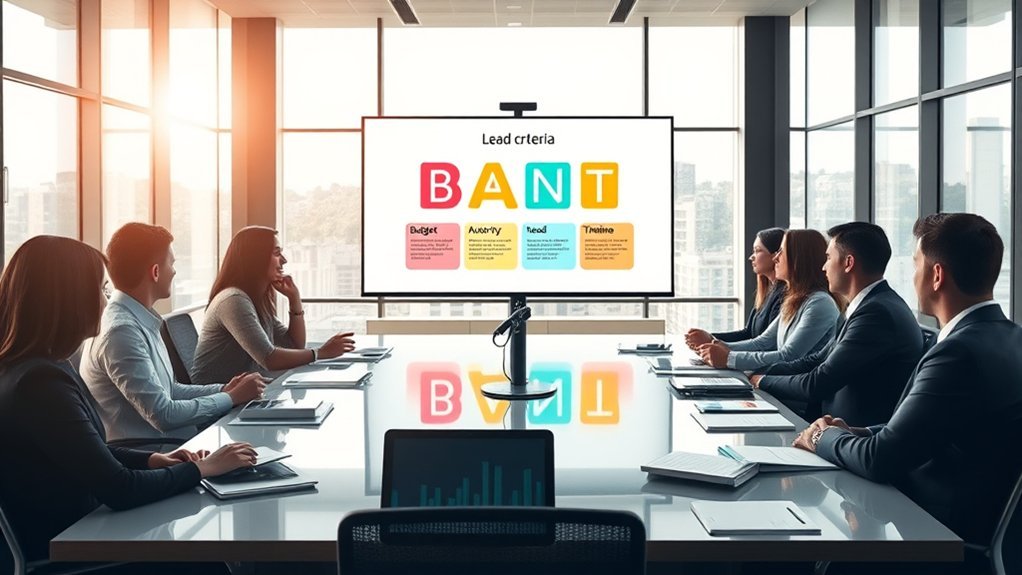
To qualify lead value in 2026, a team should score Budget and ROI fit first: is there an allocated budget, a clear cost baseline, and a justified payback window?
Next, they should verify Authority and stakeholders by confirming who signs, who influences, and whether access to the buying group is secured.
Finally, they should quantify urgency and timeline—implementation window, decision date, and next steps—so they can prioritize high-intent deals and forecast accurately.
Budget And ROI Fit
While many teams chase volume, high lead value in 2026 starts with budget validation that ties directly to ROI. Using BANT, budget allocation and ROI analysis filter prospects that can pay and will pay. Teams confirm financial readiness, quantify impact, and avoid inflated pipelines. Budget scoring should flex by deal size and cycle length, emphasizing enterprise rigor.
- Validate budget path: capture specifics in CRM (“Budget Path,” expected amount, fiscal timing) rather than yes/no.
- Tie budget to outcomes: define measurable impact (cost savings, revenue lift), then run ROI analysis to confirm payback.
- Weight scores by context: prioritize budget in enterprise; align thresholds with sales stages for forecasting accuracy.
- Operationalize checks: trigger AI-based scoring after demos or discovery, disqualifying weak budgets early to boost win rates and shorten cycles.
Authority And Stakeholders
Budget fit only converts when the right people can say yes. In BANT, decision making authority is the pivotal qualifier. Top-performing teams verify whether the contact controls budget or must loop in an economic buyer, then map every influencer shaping criteria.
They assess organizational hierarchy to confirm final approval paths, because authority verification prevents wasted cycles and raises conversion probability.
Actionably, reps should ask: Who signs? Who sets criteria? Who else must be consulted? In complex orgs, stakeholder engagement spans departments; approval authority may sit with a VP, finance, and security, each affecting the go/no-go.
Stakeholder mapping clarifies communication pathways and highlights potential roadblocks early. If authority’s unclear or absent, deprioritize and re-route to the true approver—protecting pipeline accuracy and sales resources.
Urgency And Timeline
Even before pricing or features, urgency and timeline reveal if a deal can close. In BANT, timeline assessment gauges when a prospect will decide or implement, a practice rooted in IBM’s 1950s framework and still the standard for urgency evaluation.
Short windows, firm deadlines, and rapid implementation questions are strong urgency indicators that raise lead value and forecasting confidence.
- Ask targeted questions: “What’s your decision or implementation timeline? How long does each stage take? What approvals are needed?”
- Map stages to the sales cycle to prioritize: exploring, comparing, or decision-ready.
- Score rigorously: firm deadlines earn Great/Good; vague timing lands Moderate/Poor.
- Act on signals: fast timelines get resources now; low urgency moves to nurture.
Meeting three BANT criteria, including Timeline, typically qualifies leads.
Lead Scoring With Firmographic and Intent Signals

How can revenue teams separate curiosity from real purchase intent? They start with lead scoring anchored in firmographic fit, then layer intent signals to gauge readiness.
ICP filters do the first cut:
ICP filters do the first cut: prioritize firmographic fit before layering intent signals for readiness.
+30 for employee count fit,
+25 for industry match,
+20 for geographic presence.
Decision-maker attributes refine it:
C-level +30,
VP/Director +25,
Manager +15,
verified business email +10,
and tech stack compatibility +15.
Next, intent signals change the priority. Solution searches and problem-content consumption indicate need.
Organizational cues amplify urgency:
new leadership hires +30,
funding announcements +25,
expansion news +20.
Technology adoption or adjacent tool usage adds +15 for integration potential.
Move beyond static traits with predictive and account-based scoring that aggregate signals across contacts.
A mid-sized tech company in a core vertical, spiking on external research, should route in real time—especially if they’ve engaged assets and viewed pricing.
Dynamic prioritization guarantees sellers call change-ready buyers, not casual browsers.
Behavioral Signals of Lead Quality (Visits, Keywords, Competitors)

While firmographics set the fit, behavior proves intent. Teams should read behavioral indicators through engagement metrics that separate browsers from buyers. Visit patterns matter: multiple page views, repeat visits within 24–48 hours, and time on site over three minutes correlate with conversion triggers. Pricing and demo page hits show 40% stronger readiness, while high bounce rates on the homepage signal mismatch.
- Visit patterns: Prioritize leads with repeat sessions and deep navigation; de-prioritize short sessions under 15 seconds. Competitor bounce-back visits to your site predict win rates over 30%.
- Keyword analysis: Track solution-specific searches like “implementation costs” and “outcomes metrics.” Absence of problem-defined terms implies low intent; combine brand plus competitor queries to flag active evaluation.
- Competitor insights: Contract expirations plus visits indicate switching intent; traffic from competitor referrals lifts qualification by 25% and speeds pipeline by 50%.
- Engagement depth: Prompt follow-up responses, unprompted resource reviews, and 2+ minute calls confirm readiness; volatile daily volume (>50% deviation) or arbitrage spikes predict churn.
KPIs That Prove Lead Quality: LCR, SQL Rate, CPL

Numbers-as-proof matter here: three KPIs—Lead-to-Opportunity Conversion (LCR), MQL-to-SQL rate, and Cost per Lead (CPL)—separate efficient lead gen from revenue-producing pipeline.
LCR tracks how many leads progress to opportunities in Salesforce or HubSpot; a rising LCR signals targeted content, automated email, and lead nurturing are working. A 5% lead conversion, for instance, ties top-of-funnel activity to sales outcomes.
LCR shows leads advancing to opportunities—rising rates confirm targeting, automation, and nurturing are working.
MQL-to-SQL rate shows whether sales pursues what marketing sends. High rates reflect solid lead scoring—using industry, company size, and engagement—and strong marketing alignment. Teams should pair SQL rate with win rate from SQL to Closed-Won to validate sales-readiness, especially in B2B SaaS where this bridge is the core quality KPI.
CPL quantifies efficiency (spend/leads). A $10,000 spend yielding 200 leads equals $50 CPL, but low CPL alone isn’t victory. Track CPL alongside qualified pipeline and acceptance metrics (SALs) to guarantee budget fuels opportunities, not just volume.
Pipeline Velocity: The Quality-First Math

Lead quality doesn’t just show up in LCR or SQL rate—it accelerates or drags pipeline velocity.
Velocity equals (Opportunities × Average Deal Size × Win Rate) ÷ Sales Cycle Length. It’s compounding math: each variable multiplies the others, so quality lifts the whole equation.
Example: 50 opps × $10,000 × 20% ÷ 30 days = $3,333 per day. Improve win rate or deal size, and velocity spikes even if volume drops—a core tenet of pipeline optimization strategies and sales efficiency metrics.
1) Prioritize win rate: A five-point gain often outperforms adding raw opportunities because low-quality volume dilutes velocity.
2) Upgrade deal mix: Higher average deal value magnifies every conversion, making fewer, better-fit deals the smarter lever.
3) Compress cycle length: Quality opportunities move faster, creating proportional velocity gains and earlier cash flow.
4) Trend consistently: Track identical timeframes to isolate which variable—win rate, deal size, or cycle time—drives changes and target bottlenecks where low-quality deals stall.
Playbooks: SLAs, Routing, and Follow-Up Cadence

Because pipeline speed hinges on execution, the playbook starts by locking stages, SLAs, and routing rules within 30 days, then layering a 14-day follow-up cadence by day 60.
These playbook strategies enforce SLA optimization with timers, alerts, and immediate notifications for high-scoring leads routed to senior reps. Rules-based routing—by territory, capacity, industry, and after-hours logic—prevents bottlenecks, while AI judges fit and intent to prioritize queues in real time.
By day 60, a standardized, multi-channel cadence launches: automated emails and AI-generated messages adapt to behavior and sentiment, easy to pause when conversations start.
Redistribution rules and dashboards keep stalled leads moving. Predictive scoring plus custom fit and intent signals drive assignment and next-best actions.
At 90 days, teams document integrations, ownership, and admin SOPs, align sales and marketing on scoring and handoffs, and centralize source-to-activity visibility.
Unified CRM and automation guarantee seamless handoffs, nurture delivery, and faster speed-to-lead.
Frequently Asked Questions
How Do Privacy Regulations Affect Lead Data Collection in 2026?
Privacy regulations force teams to collect less, prove consent, and prioritize data anonymization. They implement robust consent management, zero-party capture, state-specific forms, and verified sources, trading volume for compliant, high-intent leads, reducing profiling risks, and avoiding fines through audited, bias-aware scoring.
What Tools Integrate Intent, Scoring, and CRM Seamlessly?
They should pick monday CRM, Salesforce, HubSpot, or Zoho CRM. Each unifies intent data, scoring algorithms, and CRM integrations via automation tools, real-time syncing, predictive insights, and alerts—driving faster MQLs, cleaner pipelines, and measurable ROI with actionable, data-driven workflows.
How Should We Compensate SDRS for Quality-First Models?
They should pay SDRs with 60–70% base, 30–40% variable, tied to performance metrics like SALs/SAOs, meeting quality, and opportunity conversion. Compensation models include tiered commissions, quota multipliers, and event-based targets, rewarding validated pipeline, not raw activity volume.
How Do We Prevent Lead Duplication Across Channels?
They prevent lead duplication by enforcing data validation, unifying lead tracking, and automating fuzzy matching. They require unique emails, picklists, and governance. They run real-time alerts, cross-object checks, and scheduled merges, then route edge cases to owners with SLAs.
What Governance Ensures Consistent Qualification Across Regions?
They enforce regional consistency through global qualification standards embedded in CRM workflows, shared SLAs, and audited scoring. They mandate BANT/CHAMP templates, centralized MQL thresholds, quarterly call reviews, and feedback loops, then track conversion deltas by region to iterate playbooks.
Conclusion
In 2026, smart teams stop chasing volume and start pricing, scoring, and routing for quality. They define ICPs with firmographic, role, and pain signals; qualify with BANT; and validate with behavioral intent. They track LCR, SQL rate, CPL, and pipeline velocity to prove impact. They operationalize it with SLAs, instant routing, and disciplined follow-up. The math’s simple: higher-converting leads move faster and cost less per dollar won. Optimize for quality, and revenue compounds.