

Modern lead generation finds in‑market buying groups and engages them in real time, using first‑party intent, AI, and consented data. It maps funnels to observable intent, prioritizes buying‑group momentum over vanity leads, and personalizes with ABM, ICPs, and signal‑layered scoring. High‑intent demand is created with proof‑driven content (UGC, case studies, video) and captured via timely, multi‑channel outreach and automated sequences. Teams track SQLs, win rate, velocity, and ROI—because speed and precision decide who wins next.
Key Takeaways
- Modern lead generation identifies in-market buying groups using real-time intent signals, prioritizing trust, consent, and data protection over simple email capture.
- High-intent demand is created through evidence-based content—case studies, UGC, and video testimonials—that proves value and aligns with buyer research behavior.
- AI mines first-party data to predict intent, enabling real-time lead scoring, prioritization, and dynamic nurturing that accelerates movement and reduces waste.
- Multi-channel ABM engages accounts across coordinated touchpoints, increasing response rates and capturing demand where buyers actively research and compare.
- Measure effectiveness by buying-group momentum, SQLs, velocity, win rate, and ROI, focusing on quality signals and rapid first-hour follow-ups.
What Modern Lead Generation Means (In Plain English)

While “lead gen” used to mean collecting emails and drip-nurturing for weeks, modern lead generation identifies in‑market buying groups, engages them in real time, and accelerates decisions. In this evolving landscape, businesses must adopt innovative lead generation strategies to effectively capture attention and foster meaningful connections. By utilizing advanced analytics and targeted outreach, companies can not only reach potential customers but also convert them into loyal advocates. This proactive approach ensures that marketing efforts are both impactful and measurable, setting the stage for sustainable growth. These inbound lead generation strategies explained can help businesses fine-tune their marketing efforts and adapt to the ever-changing customer landscape. By focusing on personalized engagement and real-time data analysis, companies can create more tailored experiences that resonate with their target audience. Ultimately, implementing these strategies not only drives higher conversion rates but also cultivates a stronger brand loyalty among customers.
It’s the discipline of attracting, capturing, and qualifying business demand by reading behavior, not guesses. With 70% of journeys anonymous, teams pivot from capture-and-nurture to identify-and-accelerate using intent driven strategies: pricing-page hits, repeat searches, and content patterns flag readiness. As trust becomes a differentiator, leading teams build preference-led systems with clear consent paths to protect data and boost engagement.
It’s data-first. Signal-layered qualification replaces blunt MQL scoring, fusing firmographic fit with technographic shifts and buyer influence maps across dark social.
AI and automation do the heavy lifting: autonomous agents research accounts, enrich contacts, route opportunities, and shrink speed-to-lead from hours to seconds. Low-friction chat and interactive snippets convert interest on the spot across email, chat, and phone.
Operationally, agile two-week sprints test offers, content, and channels. Real-time feedback loops recalibrate targeting within 24 hours, delivering scalable, personalized experiences that move committees toward purchase.
Map Your Lead Gen Funnel to Buyer Intent

A modern funnel maps to intent, not stages on a slide. High-performing teams translate the buyer journey into observable intent signals and act in real time. They treat website depth, repeat visits, and pricing-guide downloads as decision triggers, not vanity clicks.
Engagement metrics shift from single-lead MQLs to buying-group momentum, combining account-level intent data with persona fit for precise demand capture. This approach ensures sales-marketing alignment and makes data actionable so opportunities move closer to conversion.
Content mapping aligns to research behavior: educational assets for awareness, product value for consideration, and case studies, demos, and comparisons for decision.
Lead nurturing adapts dynamically—email streams and offers advance only when behavior proves progression. Lead scoring blends actions (10 points for demos, 5 for case studies) with firmographics to time the sales handoff and keep pipelines clean. Understanding the cost analysis of quality leads is crucial for optimizing marketing budgets. By focusing on high-value prospects, businesses can enhance their return on investment and improve overall sales efficiency. This strategic approach enables teams to allocate resources more effectively to nurture relationships that truly drive revenue growth. defining a qualified lead accurately necessitates a deep understanding of customer needs and behaviors. This means evaluating both the qualitative and quantitative aspects of potential clients, ensuring that marketing efforts are directed towards individuals with the highest likelihood of conversion. Consequently, having a clear definition aids in refining targeting strategies, ultimately maximizing engagement and boosting sales conversions.
Funnel optimization tracks channel performance by stage, deal velocity, and disengagement gaps. Teams model propensity to engage years out and propensity to buy when 75% of the buying group activates.
Use AI and First‑Party Data to Target High‑Intent Buyers

Because intent hides in behavior, modern teams weaponize AI on first‑party data to spot buyers before they raise a hand. They deploy AI Strategies and Predictive Analytics to mine First Party Insights—download patterns, email clicks, event attendance—as early Intent Signals. The result: sharper Lead Qualification, tighter Behavioral Targeting, and Conversion Optimization. Forrester ties AI plus first‑party data to 2x conversion rates, 30% CAC reduction, and 20% faster cycles; a global B2B tech firm cut sales cycles 18%. HubSpot cites 50% lift in lead‑to‑customer conversions. To make these gains sustainable, teams must ensure data integrity with centralized, compliant first‑party datasets to prevent skewed AI outputs and maintain trust.
| Metric | Impact |
|---|---|
| Engagement Metrics | +35% engagement from personalized outreach; 50% better segmentation |
| Speed-to-Lead | 391% conversion lift in the first minute; five‑minute delays crush qualification by 80% |
| Pipeline Quality | 30% higher conversions from AI lead qualification; 50% more sales‑ready leads |
Teams track false positives/negatives, opportunity conversion, and stage velocity. AI-driven nurturing moves leads 23% faster, trims waste by suppressing low-intent cohorts, and focuses budget where buying is imminent.
Personalize Lead Generation With ABM, Scoring, and CRM Signals

ABM’s targeting precision isn’t optional when 97% of programs beat traditional ROI and mature teams credit 73% of revenue to it.
By fusing CRM signals with lead scoring—rooted in sales-selected accounts and firmographic intent—teams boost MQL-to-SAL conversion by 25% and accelerate pipelines. Companies using ABM also see an 11%-50% increase in average deal size.
The strategy is simple: prioritize ICP-fit accounts, score behaviors with CRM context, and fund what moves bigger deals faster.
ABM Targeting Precision
Three signals separate winning ABM from wasted spend: a sharp Ideal Customer Profile, live intent, and CRM-backed scoring.
ABM account segmentation aligns scarce resources to the 5% of accounts actually in-market, and precision targeting techniques exploit that focus. Teams that codify an ICP see 68% higher win rates; no surprise 57% now target 1,000 accounts or fewer. Multi-channel orchestration in ABA delivers 97% higher ROI than single-channel efforts, underscoring the impact of coordinated, data-driven personalization.
They research accounts, identify buying roles, and activate multi-channel ABM that delivers 97% higher ROI and a 21% cut in wasted ad spend. When competitive intent spikes 80% through the cycle, timed ABA lifts engagement 2.6x and conversions 220%.
The result: 14% pipeline conversion lift, 25–32% higher conversion rates to sales-accepted, and bigger deals—11–20%+—while 87% of marketers confirm ABM’s superior ROI.
CRM-Driven Lead Scoring
Precision ABM stalls without a scoring engine that turns signals into action.
CRM-driven lead scoring fuses rule-based scoring criteria with predictive analytics, weighting engagement metrics and firmographic fit by conversion correlation. Real time enrichment and data integration from CRM activity, web behavior, email, and third-party intent fuel immediate score updates; batch enrichment recalibrates later.
Decision-stage touchpoints—demo requests, ROI tools, pricing—earn top points, while webinar and product views signal consideration. Negative scoring filters noise: competitor signals, personal emails, unsubscribes, shallow engagement, and behavioral decay push prospects down.
Routing strategies activate outcomes: hot leads (75+) trigger senior alerts within two hours, warm leads route to MQL follow-up, cool leads enter accelerated nurture, and cold leads remain automated.
Predictive scoring achieves 75% higher conversion, prioritizing precision over guesswork.
Create Customer‑Led Content That Sparks Buying Intent

To spark buying intent, they should publish case studies that quantify outcomes by stage—pricing-page visitors convert 2.5x faster when shown proof tied to their industry and role.
They can turn intent data into proof-driven social posts—short clips and stat cards from real customers—because 83% of marketers already tailor messaging to these signals and see 220% higher CTRs.
Finally, they should script storytelling from real usage (watch-time hotspots, feature adoption, time-to-value) so prospects researching competitors see credible, comparable wins.
Case Studies That Sell
While most marketers parade features, the smartest teams weaponize case studies to trigger intent—because proof converts.
High-intent buyers want case study analysis that quantifies impact and uses effective storytelling to map pain to outcomes.
UrbanBound did it: sales-fed pain points shaped content that lifted blog traffic 37%, leads 35%, MQLs 102%, and an eBook that produced 4X leads and 4X closed wins.
ShipServ reframed an opaque category, driving 59% more visitors, 150% higher contact-to-lead, 50% higher lead-to-opportunity, 400% more sales-ready leads, while cutting campaign costs 80%.
Coca-Cola’s name-led personalization reversed decline with a 2% U.S. sales bump.
HubSpot’s customer narratives attracted intent-rich audiences.
Calendly’s invite loop turned users into proof.
Strategy: spotlight customer voice, quantify deltas, show repeatability.
Proof-Driven Social Posts
A feed packed with proof beats any polished brand pitch. Modern lead gen favors proof driven authenticity over slogans. Brands that spotlight reviews, UGC, and influencer receipts trigger social validation and buying intent. The data’s blunt: UGC lifts conversions 4.6% on average and up to 166% on product pages. Reviews push 12.5% higher conversion; good ratings make buyers spend 31% more. Video testimonials drive 80% higher uplift than text, and sales-proof notifications boost conversions 98%. As brands prepare for lead quality metrics for 2026, they should focus on gathering authentic customer insights to stay ahead. By investing in these metrics, companies can better understand their audience and refine their marketing strategies accordingly. The evolution of social proof in consumer behavior shows that transparency will be key in driving future conversions.
| Lever | Impact |
|---|---|
| UGC on pages | Up to 166% conversion lift |
| Video testimonials | 80% higher uplift vs. text |
| Reviews present | 12.5% higher conversion |
| Shoppable posts | 32% more click-throughs |
| Influencer trust | 41% stronger ROI |
Execute: prioritize UGC, high-signal metrics, shoppable formats, and credible creators.
Storytelling From Real Usage
Because buyers trust proof over polish, storytelling from real usage becomes the shortest path to intent—and the numbers back it.
Eighty-two percent prefer brands with a content presence, and 72% of marketers see customer engagement rise when narratives showcase actual usage. Case studies hit 15% binge rates and known visitors binge demos at 21%, proving narrative impact outperforms generic blogs.
Strategically, brands should capture demand with gated assets and communities: 68% use webinars to gather first‑party data, 77% drive direct engagement, and 52% mine behavioral insights to personalize stories.
Personalization amplifies outcomes—40% craft account‑specific content and 33% tailor to buying stage. ROI follows: 93% cite video from real usage delivering strong returns, while 54% track conversions and 58% monitor social lift to validate customer‑led storytelling.
Launch Human‑Sounding Multi‑Channel Lead Generation
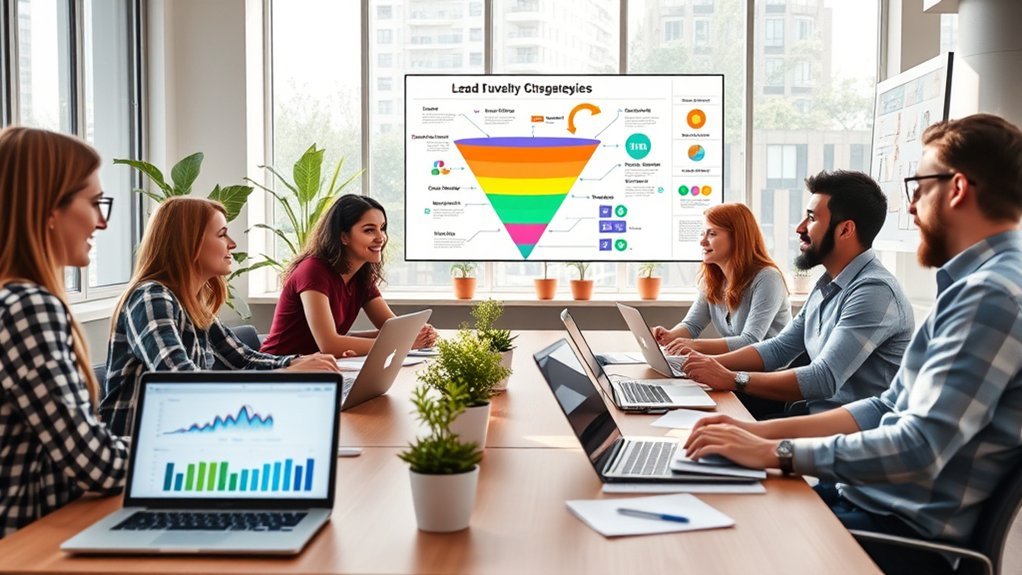
Sometimes the most “human” outreach is algorithmically orchestrated. High-performing teams blend AI precision with human interaction, using multi channel strategies that mirror how buyers actually decide.
Data shows sales sequences with 3+ channels deliver 287% higher response and purchase rates, while AI-assisted personalization lifts conversions up to 20%. The playbook: orchestrate LinkedIn, phone, email, SMS, and voicemail with AI-tuned timing and message variants, then insert live touchpoints where they matter.
Prioritize phones for executives—57% of C‑level buyers prefer calls. Drop tailored voicemails referencing industry triggers. Use employee advocacy to inject authentic voices—expect roughly 25% more leads.
AI generates emails that cite relevant case studies, while chatbots qualify 24/7, route high‑intent visitors, and sync with monday CRM for real-time handoffs. Promote webinars 3–4 weeks out across channels, reinforce with reminders, and follow up instantly with recordings.
Measure lift by channel and tighten sequences; AI-guided follow-ups raise win rates 27%.
Capture Demand: Forms, Pixels, and Automated Sequences

Precision outreach only works if it captures intent the moment it appears. He deploys form optimization on high-converting landing pages—Unbounce, Instapage, or HubSpot—to trade lead magnets for precise contact data, then routes it to CRM via marketing automation.
Pixel integration tracks behavior, powering data segmentation and conversion tactics that escalate when visitors click, chat, or linger. Interactive content doubles conversions and 5x pageviews; chatbots lift B2B conversion rates up to 20% and expand lead volume by 10–20%.
- Targeted CTAs, time-sensitive offers, and personalized reminders trigger immediate action and raise CTR while controlling CPA.
- Automated follow ups stitch sign-up forms, segmented email/SMS, and CRM into orchestrated journeys for disciplined lead nurturing.
- AI lead scoring prioritizes sales-ready prospects, reducing acquisition costs up to 60% and scaling pipeline efficiency.
He measures and optimizes engagement strategies in real time, using pixels and marketing automation to adapt sequences, update scores, and tighten handoffs the moment intent signals fire.
Measure Lead Generation: SQLs, Win Rate, Velocity, ROI

While teams obsess over volume, growth hinges on four metrics that expose truth: SQLs, win rate, velocity, and ROI. SQL analysis starts with MQL to SQL conversion: averages sit at 13% overall, but B2B SaaS reaches 39-40% and B2C often hits 18-22%. Lead scoring can boost conversion up to 40%, and first-hour follow-up drives 53% acceptance.
Growth isn’t volume; it’s SQLs, win rate, velocity, ROI—optimize conversion, scoring, and rapid follow-up.
Segment by industry—Consumer Electronics 21%, FinTech 19%, Automotive 18%—to set targets and pressure-test quality.
Win rate is the reality check. B2B closes at 20-35%; SaaS lands 31-39% opportunity-to-won, professional services 25-40%. Weak win rates expose poor qualification—prioritize pain confirmation and ROI clarity.
Velocity metrics reveal where deals stall. Minutes-to-response beats hours, and SEO-led funnels convert MQL to SQL at 51% versus 26% from PPC. Trials activated in 7-14 days convert 25-45% with guided onboarding.
ROI evaluation ties it together: healthy 20-30% MQL-to-SQL, tracked rejection reasons, and tight SLAs compound efficiency.
Pick a Lead Generation Stack: Intent, Sequencing, CRM, Analytics

Because lead gen performance now hinges on signal quality and speed-to-action, teams should architect a stack around four pillars: Intent, Sequencing, CRM, and Analytics. Understanding lead conversion strategies is essential for optimizing these pillars. By effectively aligning intent with the right sequencing, teams can significantly enhance their CRM utilization. Furthermore, robust analytics offer insights that refine the overall lead conversion process, ensuring a continuous improvement cycle. One crucial aspect of effective lead generation strategies is the ability to forecast customer behavior and preferences accurately. This allows teams to tailor their outreach efforts more effectively, increasing the chances of conversion. Additionally, leveraging automation tools can streamline the engagement process, making it easier to manage large-scale campaigns while maintaining a personal touch.
Start with intent signals that combine verified buyer-intent with contextual account and technographic data. Track first-party visits, content engagement, topic research, and AI-monitored events (job changes, social activity, technology adoption). Prioritize high intent targeting with predictive scoring and ICP fit to shrink waste.
Deploy sequencing strategies that trigger automated outreach within minutes of intent spikes. Orchestrate multi-step email, LinkedIn, calls, and SMS with AI personalization, throttling controls, dynamic audiences, and sequence engagement scoring.
Tie every touch to crm integration so priority accounts, next actions, and UTMs route instantly, while low-intent cohorts nurture.
Use analytics insights to expose pipeline dollars per lead, conversion lift by intent cohort, and reply rates vs. baseline. Make data driven decisions with predictive modeling and AI lead scoring.
- Quantify buyer engagement via sequence scores.
- Compare intent vs. non-intent cohorts over time.
- Attribute revenue across inbound/outbound touchpoints.
Frequently Asked Questions
How Do Privacy Regulations Affect Cross-Border Lead Generation Campaigns?
Privacy regulations constrain cross-border lead generation by tightening data protection, amplifying compliance challenges, and fragmenting international regulations. They force verifiable consumer consent, jurisdiction-aware data routing, and vendor audits, or campaigns risk penalties, blocked transfers, and degraded reach. Strategic automation and geo-segmentation mitigate friction.
What Budget Benchmarks Suit Startups Versus Enterprise Lead Gen?
Startups target 5–10% revenue as startup budgets; enterprises commit 10–15% as enterprise allocations. They prioritize ROI metrics: startups bet on SEO/content and founder-led motion; enterprises fund ABM, paid media, analytics. Scaling strategies shift from organic dominance to diversified, multi-channel orchestration.
How Should Sales Compensation Align With Marketing-Sourced Leads?
Tie sales compensation to marketing-sourced pipeline, not volume. He rewards sales incentives for qualified, target-account opportunities and retained revenue, prioritizing lead quality. Track source-to-close; pay more for nurtured, high-intent deals. This provokes discipline, lifts win rates, and eliminates junk leads.
What Legal Considerations Exist for Ai-Driven Personalization?
Legal considerations demand enforceable Consent management, Algorithm transparency, and clear Data ownership terms, grounded in GDPR/CCPA/DPDP compliance. Teams must audit bias, disclose tracking, verify IP rights, and embed AI ethics, or face penalties, reputational damage, and suppressed personalization ROI across jurisdictions.
How Do You Localize Lead Gen for Non-English Markets?
They localize lead gen by translating and testing content, aligning ICPs to cultural nuances and regional trends, optimizing hreflang SEO, targeting high-intent queries, deploying localized ABM and chatbots, and scoring leads with region-specific behaviors, firmographics, and BANT signals.
Conclusion
Modern lead generation isn’t guesswork—it’s precision. Teams that map funnels to intent, fuel targeting with AI and first‑party data, and personalize with ABM and CRM signals outperform. They create demand with customer‑led content, orchestrate human‑sounding multi‑channel plays, and capture it through friction‑smart forms, pixels, and automated sequences. They measure SQLs, win rate, velocity, and ROI relentlessly. The strategic edge comes from stack alignment—intent, sequencing, CRM, analytics—and the courage to kill low‑intent noise fast. In today’s landscape, effective lead generation strategies since ai impact have transformed how businesses connect with potential customers. Companies that leverage advanced analytics and predictive modeling are not just capturing attention but also fostering deeper relationships through tailored experiences. The integration of these technologies enables teams to navigate complexities and enhance their outreach efforts, ensuring they stay ahead in a competitive market.