

After a lead is captured, the journey becomes structured: define a true lead vs. lifecycle stage, score fit and intent, and progress from MAL and MEL to MQL. Enforce MQL-to-SQL SLAs, with persona fit and score thresholds, and engage within 5 minutes to lift conversion 9x. Convert SQLs to opportunities (36–50% benchmarks), run weekly pipeline reviews, and close with strong objection handling and ROI framing. Post-sale, compress time-to-value, drive adoption, and track CSAT/NPS—there’s more that sharp teams can apply next.
Key Takeaways
- Leads progress through lifecycle stages: MAL → MEL → MQL → SAL → SQL → Opportunity → Customer, each reflecting increasing fit, intent, and readiness.
- Qualification combines fit and engagement scoring; hot MQLs get contacted within 5 minutes to 9x conversion likelihood.
- MQL-to-SQL handoff uses shared SLAs: defined criteria, response times, acceptance rules, and continuous feedback to refine scoring.
- SQLs convert to opportunities via nurturing, pipeline reviews, and measuring velocity; benchmarks show 36–50% SQL-to-opportunity conversion.
- Post-sale focuses on onboarding, compressing time-to-value, tracking adoption and NPS/CSAT, and triggering data-driven retention and expansion.
True Lead vs. Lifecycle Stage: Clear Definitions
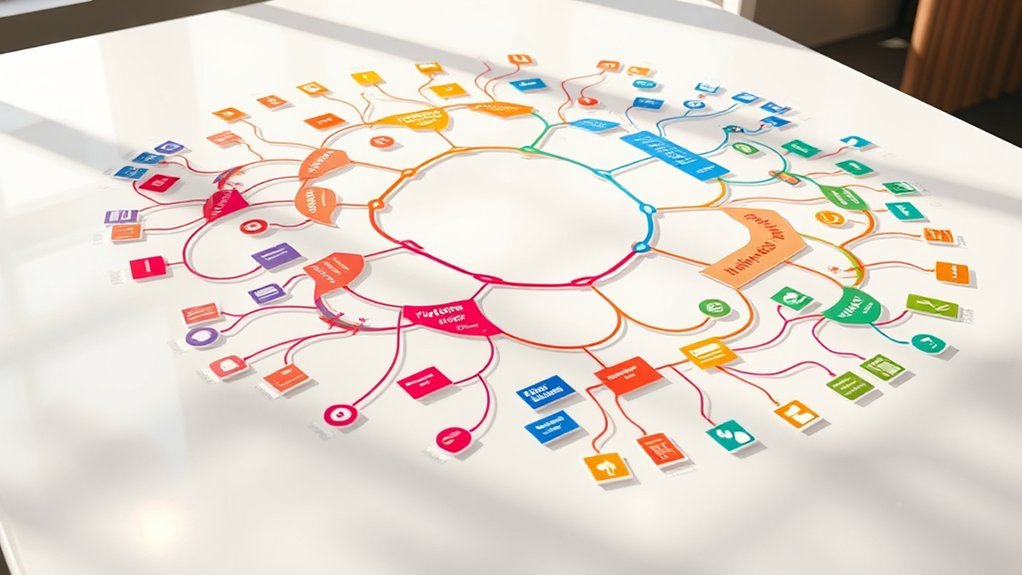
Although teams often blur the terms, a “true lead” isn’t a lifecycle stage—it’s the raw unit of demand: a known contact (individual or organization) that’s shown interest and could become a customer. The lead definition is concrete: captured contact information (name, email, phone, or address) plus signals of interest. It can include demographic or professional data to sharpen targeting and qualification. This baseline entity powers the revenue pipeline but isn’t progress; lifecycle stages describe progress.
Strategically, categorize the true lead by evidence. An unqualified lead shows initial engagement—forms, downloads, webinars—without verified budget, authority, or intent and may not match the ideal profile. HubSpot Sales Hub can automate lead scoring to prioritize outreach by assigning points based on engagement, fit, and buying signals.
A qualified lead meets BANT, shows clear buying signals—pricing visits, demo bookings—and aligns to target personas, warranting focused outreach. Subsets inside lifecycle stages, such as MQLs and SQLs, reflect increasing validation: marketing-driven engagement first, then joint sales-marketing vetting for sales-readiness.
Precise separation reduces waste and sharpens conversion forecasting.
Lead Lifecycle: First Touch to Customer

From first touch, the team optimizes visibility and credibility across search, social, and reviews to shape expectations and capture attention before competitors.
They then qualify and prioritize using MQL/SQL thresholds, engagement signals, and status-driven workflows to focus resources where conversion probability is highest. Investing in a CRM system enhances lifecycle tracking and personalization by consolidating interactions across stages, strengthening customer lifecycle management.
Finally, they convert and retain through risk-reduction offers, clear timelines, and strong onboarding that accelerates adoption and sustains outcomes.
From First Touch
Before a lead ever fills a form, the lifecycle begins at first touch—the initial brand encounter via search results, social posts, reviews, or word of mouth—and it should be measured with intent.
At this stage, teams quantify brand awareness with directional and diagnostic metrics. They track website visitors (unique vs. returning), organic impressions, and click-through rates to spot message-market fit. Lifecycle stages should never regress, while lead statuses can fluctuate based on sales insights, helping teams maintain accurate segmentation and reporting across the journey.
Social reach, follower growth, and engagement rates reveal content resonance. Share of voice benchmarks mentions against competitors, while pre/post-event surveys verify recall lift.
They also compare channels by lowest cost per first visit and highest qualified traffic percentage to prioritize budget.
Time from first touch to conversion establishes baselines. Email open and click rates, plus visitor-to-lead conversion, validate if awareness is translating into meaningful momentum.
Qualify And Prioritize
Two levers separate momentum from noise: qualification and prioritization. He operationalizes both with lead scoring that blends fit and interest: +15 for target company size, +10 for Director title, behavioral insights like demo or pricing views, and negative signals (personal email, unsubscribes). Contacting a lead within 5 minutes of MQL threshold increases conversion likelihood by 9x, underscoring the impact of immediate engagement. Scoring thresholds route outcomes: ≥60 becomes MQL for sales, 30–59 enters nurturing processes, <30 stays raw after lead validation. AI augments qualification strategies with convert likelihood (e.g., 80%) aligned to stages.
Prioritization techniques tier by warmth, account size, and lifecycle phase, elevating decision/negotiation activity. Frameworks such as BANT, CHAMP, and MEDDIC add readiness and authority, addressing why 67% of sales is lost to poor qualification.
He audits conversion metrics quarterly, adjusting weights by win rates, stage velocity, and source performance to protect pipeline quality.
Convert And Retain
While qualification sets the stage, conversion and retention win the game by compressing time-to-value and compounding trust. With average lead conversion at 2–3% (B2B 1–2%), precision matters. Professional services hit 9.3%, but many sectors lag, so teams lean on conversion strategies that speed response and relevance. External digital marketing agencies can provide strategic support that helps Marketing shift from reactive to proactive strategies by improving alignment between Sales and Marketing. Implementing effective lead conversion strategies for businesses can dramatically enhance the bottom line, particularly when focused on enhancing customer engagement. By leveraging data analytics and targeted content, companies can refine their approach and maximize conversion opportunities. Additionally, investing in training for sales teams can foster better communication with prospects, leading to increased trust and higher conversion rates.
Replying within five minutes lifts conversions 9x; connected journeys cut acquisition cost 45% and increase renewals 44%. Since 96% of visitors aren’t ready, lead nurturing and engagement tactics—segmentation, targeted content, and closed-loop feedback—move MQL to SQL faster (13% in B2B SaaS).
- Tighten velocity: track MQL→SQL→Closed; protect momentum with disciplined follow-up.
- Optimize touchpoints: 1-second pages triple conversions; landing pages average 9.7%.
- Invest in retention: data-driven programs deliver 46% higher engagement, compounding customer retention.
Qualification Criteria That Actually Predict Fit

Because lead quality determines revenue efficiency, qualification criteria should focus on signals that reliably predict fit and purchase intent. A rigorous fit assessment blends firmographic and demographic indicators with behavioral intent, BANT, and predictive scoring. Teams should codify qualification metrics that correlate with closed-won patterns and prune vanity signals.
- Firmographic fit: size, industry, geography, business model, and operational status.
- Demographic fit: role, department, decision influence, verified identity, contact validity.
- Behavioral intent: depth, frequency, recency, product usage, and qualification responses.
- BANT: budget, authority, need, and timeline interplay.
- Predictive scoring: weighted actions and role-tech alignment that rank ICP and intent fit.
| Criterion | High-Signal Example | Action |
|---|---|---|
| Firmographic | 500–2,000 employees, target industry | Route to AE |
| Behavioral | Multi-visit, feature trial, recent clicks | SDR outreach |
| BANT/Predictive | Budget confirmed, signer, high score | Schedule demo |
Operationalize with thresholds, weights, and SLAs; then retrain models quarterly as high-scoring conversions refine rules and low-scoring wins expand coverage.
MAL, MEL, MQL: What Each Status Means

This section clarifies how a Marketing Accepted Lead (MAL) signals basic fit and ownership by marketing, while a Marketing Engaged Lead (MEL) reflects measurable interactions like opens, clicks, or webinar attendance.
It then pinpoints when those engaged contacts become Marketing Qualified Leads (MQLs) based on predefined thresholds—e.g., content depth, frequency, and firmographic match.
With crisp definitions and criteria, the team can prioritize nurture, forecast pipeline, and time the sales handoff with confidence.
Defining MAL And MEL
Before anyone calls a lead “qualified,” teams need clear lines between MAL, MEL, and MQL to keep the funnel honest.
A Marketing Accepted Lead (MAL) is raw awareness: a contact enters the database without behavioral thresholds. MAL characteristics include minimal data, unscored intent, and undefined fit—useful for reach, not readiness.
A Marketing Engagement Lead (MEL) signals traction. MEL engagement reflects low-commitment actions—site visits, ad clicks, social interactions—captured before deeper qualification. It bridges raw acquisition to structured scoring, ensuring resources focus where interest appears.
- MAL: presence without proof—no engagement minimums, no qualification signals yet.
- MEL: early interaction—track visits, CTA clicks, basic content touches to gauge momentum.
- Governance: revisit stage definitions using sales feedback and engagement metrics to reduce leakage.
When Leads Become MQLs
Once a lead moves beyond raw presence (MAL) and early clicks (MEL), it becomes a Marketing Qualified Lead (MQL) when marketing confirms both fit and return interest against predefined criteria.
An MQL reflects verified lead engagement—form submits, opted-in emails, repeated visits, content downloads, or webinar attendance—weighted by lead scoring. Teams validate fit (ICP match) and interest (behavioral signals), using historical win/loss patterns and content interaction to quantify higher conversion likelihood.
The shift typically follows gated-content submission, then deeper interactions like pricing page views or CTA clicks. Marketing accepts these contacts for focused nurturing strategies, not immediate sales pursuit.
MQLs precede SALs and SQLs; they’re promising, not purchase-ready. Next steps include targeted nurture sequences, sales review for readiness, conversion tracking, and feedback loops that recalibrate criteria over time.
MQL to SQL: Handoff Rules and SLAs

Although marketing and sales often debate definitions, the MQL-to-SQL handoff works when both teams codify criteria and response times in a shared SLA—then live by it. Handoff efficiency improves when sales alignment anchors what “good” looks like: MQLs meet persona fit and intent; SAL marks sales acceptance; SQLs meet BANT and readiness behaviors.
The SLA sets maximum response times for new MQLs, strict follow-up windows for SQLs, and rules to reassign unactioned leads. It also fast-tracks high-intent signals and routes others to targeted nurture.
- Define acceptance rules: persona, segment fit, lead score thresholds, and AI-predicted buy likelihood as a prioritization signal.
- Enforce timelines: minutes-to-first-touch on hot MQLs, benchmarked cadence for SQL follow-up, and reassignment if SLAs lapse.
- Instrument measurement: track MQL→SQL rate, monitor stage drop-offs, and iterate scoring with sales feedback.
Teams that automate qualification, inspect conversion rates, and adjust thresholds forecast more accurately and shorten cycles.
Converting SQLs to Opportunities Smoothly

Even with clear MQL-to-SQL rules, momentum stalls unless sales turns SQLs into opportunities fast, predictably, and with intent signals front and center.
Teams should anchor on benchmarks: SaaS converts 36–42% of SQLs to opportunities; B2B funnels often hit 50–62%, with an average near 50%. If 120 SQLs land, expect roughly 30 opportunities at a healthy 25% rate.
Anchor on benchmarks: 36–62% SQL-to-opportunity; assume ~50%. 120 SQLs → ~30 opportunities at 25% rate.
Industry and source matter: referrals outperform (14.7% SQL-to-win), social 8.5%, email 7.8%, while webinars and events trail; product-led tech sees a 23% lift from in-app behavior.
To raise yield, apply SQL nurturing strategies that map engagement to intent—shared lead scoring improves accuracy 22%, AI models add 31%, and SLAs cut handoff time 48%.
Weekly pipeline reviews increase acceptance 28% and reduce the 22% annual lead loss from misalignment. Measure SQL velocity (days to opportunity), attribution gaps (>20%), and conversion by source in CRM dashboards.
Then deploy precise opportunity engagement techniques immediately upon qualification.
Working the Opportunity: Objections, Pricing, Timing

While momentum shifts from qualification to closing, the best teams treat objections, pricing, and timing as signals to guide the deal—not stalls to avoid.
Data from a million calls shows effective objection handling can lift win rates up to 30%. Top reps pause longer, keep a 43:57 talk-to-listen ratio, and use the Four P’s—pause, probe, paraphrase, provide—to convert situational, price, and trust concerns. They respond with questions 54.3% of the time, not monologues.
Pricing strategies matter: leaders overcome price pressure 81% more often without discounting by tying cost to ROI, risk reduction, and proof points. They track patterns in CRM and personalize rebuttals using company specifics.
Timing techniques turn “not now” into next steps. With 80% of sales needing five touches, follow up importance is decisive. Teams propose low-pressure trials, confirm resolution, schedule based on prospect activity, and use smart reminders to sustain momentum.
- Pause, probe, paraphrase, provide.
- Link price to value, ROI, and risk.
- Persist with personalized, scheduled follow-ups.
After the Sale: Onboarding, Adoption, Retention

Momentum at close only matters if it converts into value fast. Post-sale execution hinges on onboarding strategies that shorten time to first value and spark user engagement. Teams apply data-driven optimization to spot friction, then trigger proactive human touch when users stall or hit milestones. Structured discovery sessions align use cases and success metrics, while relationship diversification guarantees at least five personas see clear product value. Early wins, checklists, and progress bars speed activation; 76% of firms use progress visualization, and 48% deploy checklists.
They blend welcome screens and microsurveys for immediate customer feedback, prioritize videos (preferred by 65% of users), and layer in-app guidance—tooltips, tours, and resource centers—to scale enablement.
| Lever | Why it matters |
|---|---|
| TTFV | Strong predictor of retention |
| Feature adoption | Depth signals future expansion |
| Login frequency | Early risk indicator |
| CSAT/NPS at completion | Validates onboarding quality |
Retention follows adoption: measure, iterate, and empower real people to intervene precisely when data says momentum’s at risk.
Lifecycle Benchmarks: Conversion Rates and Health Metrics
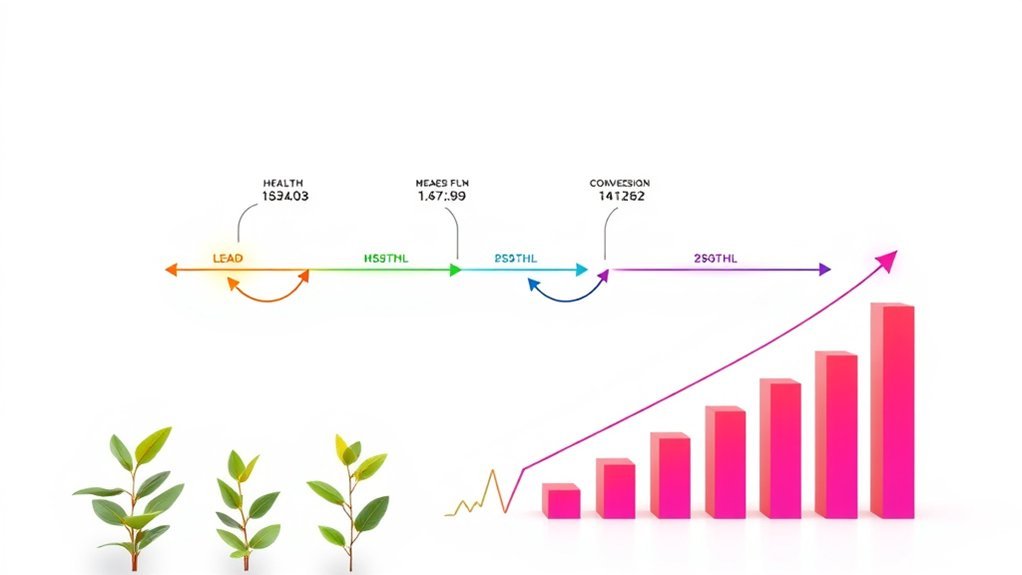
Because growth depends on knowing where funnels leak, teams anchor lifecycle reviews in hard benchmarks across stages and channels. They compare lead-to-MQL conversion benchmarks by source—email at 38%, PPC 29%, conferences 28%, trade shows 24%, webinars 19%—and by industry, where Solar Energy hits 45% and B2B SaaS reaches 39%.
From MQL-to-SQL, they expect 12–21%, while lead-to-opportunity averages 12%. Channel conversion benchmarks guide mix: Google Search at 4.40%, Display 0.57%, paid search 3.2%, organic 2.7%, direct 3.3%.
They track health metrics that predict revenue velocity: median landing page CVR 6.6% vs a 2026 average 1.5–2.5% (top decile 3.5–5%). They quantify lead conversion rate and lead-to-sale to spotlight friction.
- Adopt machine learning scoring; it lifts conversion 75% and top teams hit 6% B2B vs 3.2% average.
- Rebalance budget toward channels beating baseline CVRs.
- Set stage targets; trigger repair when variances exceed ±20%.
Frequently Asked Questions
How Should We Handle Leads From Partner Referrals Differently Than Inbound?
They prioritize partner referrals with instant routing, personalized outreach, and SLA-backed speed-to-lead. They strengthen partner communication, apply referral tracking, and benchmark conversions (10–25%) versus inbound (5–10%). They assign senior reps, leverage references, and tailor CTAs to capitalize on warmer intent.
What Data Privacy Practices Apply When Enriching Lead Profiles?
They prioritize data minimization, purpose limitation, and first-party sources, enforce explicit opt-ins via robust consent management, append consent timestamps, apply pseudonymization, define retention timelines with auto-deletion, and harden data security through encryption, access controls, MFA, audits, and vendor DPAs for compliance.
How Do We Localize Lifecycle Stages for International Markets?
They localize lifecycle stages by mapping regional buyer behaviors, adjusting qualification triggers, and aligning SLAs. They use lead localization, market adaptation, localized content, and sales cadence tests. They validate with conversion data, consent norms, CRM segmentation, and iterative, geo-specific benchmarks.
Which Tools Best Unify Marketing and Sales Lead Data Sources?
They should prioritize Salesforce or HubSpot APIs for real-time data integration, then layer LeadsBridge or Zapier for workflow automation. For scalable lead management, Improvado or Rapidi unify sources; ZoomInfo or Apollo.io enrich records, improving attribution, forecasting, and conversion visibility.
How Do We Recover Stalled Leads After Long Periods of Inactivity?
They revive stalled leads with data-driven lead nurturing and re engagement strategies: segment by intent, score and prioritize, launch coordinated email/SMS/phone/retargeting, add limited-time offers, and deploy AI for timing and rep-matching—driving 10–15% conversions and 108% higher multichannel lift.
Conclusion
In wrapping up, the team should treat the lead lifecycle as a measurable system, not a mystery. Clear definitions, predictive qualification, and crisp MAL/MEL/MQL/SQL rules create reliable handoffs. SLA-driven motion reduces leakages; documented objection handling and pricing guard the opportunity stage. Post-sale, tight onboarding and adoption drive retention and expansion. Track conversion rates by stage, time-to-stage, win rates, and churn. With shared KPIs and feedback loops, they’ll turn more first touches into customers—and customers into advocates. Understanding common reasons leads fail to convert can pinpoint weaknesses in the process. By analyzing lead interaction and feedback, teams can refine their outreach strategies and improve engagement. Ultimately, this leads to a more efficient funnel, turning potential customers into loyal advocates.