

SaaS lead gen targets research-driven buyers over longer cycles, optimizing MQLs/PQLs via LinkedIn (82% of B2B social leads), SEO, content, and webinars; success ties to LTV:CAC and ARR. Local services capture urgent, proximity-based demand through Google Business Profile, Local Services Ads, reviews, and rapid response—at far lower CPLs (~$23 vs B2B SaaS ~$188–$310 paid). Referrals and AI chatbots cut costs and lift conversions. Tactics shift by goals, budget, and timeline—here’s how to choose the right mix next.
Key Takeaways
- Buyer intent and timelines differ: SaaS nurtures research-driven buyers over months; local services capture urgent, proximity-based demand converting in days or hours.
- Channel mix diverges: SaaS leans on LinkedIn, SEO, content, and demos; local services prioritize Google Business Profile, Local Services Ads, maps, and reviews.
- Metrics shift: SaaS tracks MQL/SQL/PQL, LVR, CAC, and ARR; local services focus on CPL, SQO cost, meetings booked, attended rates, and cash flow.
- Budget and CAC expectations vary: SaaS accepts higher CPLs for scalability; local services optimize for low CPL, fast ROI, and immediate bookings.
- Conversion drivers contrast: SaaS uses nurturing, PLG, webinars, and remarketing; local services win on speed-to-lead, availability, review velocity, and geo-targeting.
How SaaS vs Local Services Lead Generation Differs

While both aim to capture demand, SaaS and local services generate leads in fundamentally different contexts: SaaS targets research-driven buyers across regions with multi-touch journeys (trials, demos, approvals), whereas local services capture geographically qualified, high-intent users ready to hire now.
For SaaS, lead generation hinges on SaaS nurturing: SEO and content feed trials and demos, remarketing sustains SaaS engagement, and PLG removes friction. Benchmarks matter—organic search often delivers ~$164 CPL, LinkedIn Ads trends near $394 CPL—so they’ll optimize for LTV:CAC ≥ 3:1 and extend marketing into onboarding and retention. National campaigns emphasize scale and scope, leveraging volume, branding, and broad lead distribution supported by robust CRM and compliance.
Local urgency shapes a tighter funnel. Geo-targeted LSAs, Google Business Profiles, and Google Guaranteed badges drive Local conversion without heavy keyword research.
Leads are pre-qualified by location and intent, so close rates rise and cycles compress—often from first call to booked job.
Actionably, SaaS builds multi-touch sequences and activation metrics; local prioritizes response time, reviews, and territory coverage to dominate immediate demand.
Choose Your Mix: Goals, Budget, and Timeline

Given those different buyer contexts, the right mix starts with clear definitions of success, matched spend, and realistic timing. For SaaS, goal alignment anchors on MQLs, SQLs, PQLs, ARR attainment, and LTV:CAC; for local services, it’s SQOs, meetings booked/attended, and quick cash flow.
Use budget flexibility to map spend to channel prioritization: SaaS favors SEO, content, and multi-touch ABM despite higher CAC; local services emphasize low CPL in high-intent ads and outreach that drive immediate bookings. Companies that regularly audit tracking setups and focus on metrics tied to revenue growth see more predictable scaling and efficiency because they avoid vanity metrics and emphasize lead quality.
Timeline expectations diverge: SaaS plans for longer cycles, tracks lead velocity rate and MQL-to-SQL to guide conversion strategies; strong performers hit 10–15% lead-to-customer over months.
Local services optimize short time-to-sell, monitor meetings as pipeline predictors, and calculate lead value to prune waste.
Ensure marketing integration with shared performance metrics: SaaS dashboards show LVR, PQL growth, and CAC by channel; local services track CPL, SQO cost, and attended-rate.
In both, prioritize lead quality over volume.
Who You’re Targeting: ICPs vs Nearby Buyers

Two very different targets demand two very different playbooks. For SaaS, ICP targeting centers on buyer personas like IT, ops, or finance leaders who value low upfront costs, subscriptions, vendor-managed updates, and analytics-driven decisions. They expect remote access, quick deployment, and personalization strategies that reflect usage data and dynamic pricing. Local services focus on nearby buyers with a geographic focus and service immediacy—property managers, hotels, restaurants—where customer urgency, inventory, and proximity drive action. Industry differences and local adaptability shape messaging, proof, and offers. For CAE-focused SaaS, buyers increasingly weigh hardware costs alongside subscription renewals, training time, and scalability when comparing cloud tools to on‑prem alternatives.
| SaaS ICP Targeting | Local Nearby Buyers |
|---|---|
| Data-led buyer personas across industries | Proximity-led personas in verticals like tourism |
| Values scalability, low IT overhead | Values availability, logistics, and speed |
| Personalization via behavior analytics | Personalization via neighborhood cues |
| Global or niche reach, remote delivery | Regional radius, on-site fulfillment |
| Trials/demos reduce switching risk | Social proof and fast quotes close deals |
Action: map personas, quantify urgency signals, align offers to immediacy vs longevity.
Lead Gen Channels: LinkedIn and SEO vs Google Local and Ads
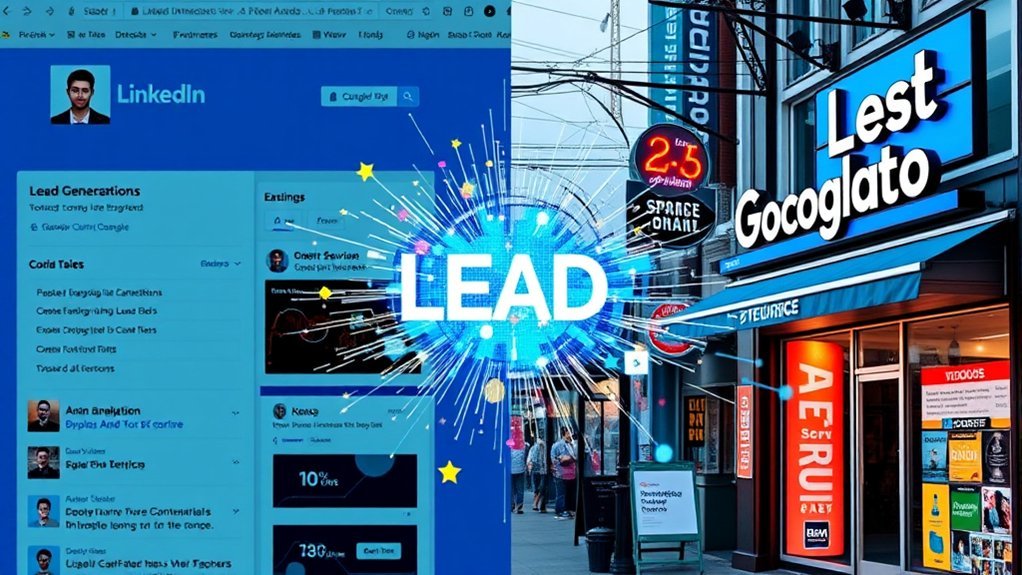
For SaaS, LinkedIn offers targeting precision at scale—reaching 900M professionals, generating 82% of social B2B leads, and converting Lead Gen Forms at 13%. LinkedIn remains the most trusted social media platform for professionals, which strengthens engagement and conversion quality for B2B campaigns.
Pair it with SEO to capture high-intent queries cost-effectively (avg organic CPL ~$164; 2.9% conversion) and compound returns over time.
For local services, prioritize Google Local visibility—local pack and GMB—then layer Google Ads and Local Services Ads that sit above organic, drive 28% of clicks, and convert urgent demand at $30–50 CPL.
LinkedIn Targeting Precision
Anyone comparing lead gen channels will see LinkedIn’s targeting precision stand out for B2B. With LinkedIn precision targeting and audience segmentation by role, industry, company size, and skills, teams reliably reach niche buying committees. Over 65 million decision-makers are active, and Insight Tag lifts accuracy by 38%. Audience forecasting boosts campaign efficiency by 18%, while Lead Gen Forms average 13% conversion. Sponsored Content CTR lands around 0.4–0.6%; Message Ads average 3.2%. LinkedIn is projected to exceed 1.3 billion members by 2026, reinforcing its scale and reach for B2B targeting.
| Lever | Actionable takeaway |
|---|---|
| Role/skill filters | Prioritize skill-based targeting for niche ICPs. |
| Insight Tag | Install sitewide to fuel retargeting accuracy. |
| Audience forecasting | Trim waste; set reach and budget guardrails. |
| Lead Gen Forms | Shorten fields; sync to CRM for speed-to-lead. |
| Creative testing | Rotate problem-led hooks; refresh every 2–3 weeks. |
Compared with Google’s broader local intent, LinkedIn delivers 28% lower CPL and 227% better lead-gen efficiency, driving 46% of B2B social traffic and 80% of social leads.
SEO For B2B Intent
While LinkedIn pinpoints buyers, SEO compounds intent at scale—pulling in prospects already researching solutions.
In B2B SEO, an Intent Strategy starts with Keyword Research mapped to pain, use case, and role. It’s data-backed: 59% say SEO drives lead goals, 57% say it generates more leads than any channel, and Organic Traffic can deliver 44.6% of revenue.
Teams prioritize Lead Quality, using Content Optimization and strategic landing pages to lift Conversion Rates; interactive assets often double conversions and 5x pageviews.
Track Performance Metrics—SERP coverage, Search Visibility, funnel CTRs, and sales-qualified rates—to avoid vanity wins.
Add AI chat and conversational flows to capture context and boost User Engagement; many report up to 20% conversion lifts and faster qualification.
Google Local Visibility
SEO scales intent, but local buyers act faster—Google’s ecosystem captures them at the moment of need. For local services, local search optimization should prioritize Google Business Profile, Maps, and the Local Pack where 44% of clicks land.
Verified profiles see around 200 interactions monthly, and 76% of mobile local searchers visit within 24 hours—proof that mobile engagement converts. Reviews drive trust and ranking: detailed, location-referenced feedback outperforms volume.
Keep profiles “alive” with posts, photos, Q&A, and rapid message response to lift engagement signals.
- Optimize listings: categories, services, photos, messaging, and UTM tracking.
- Engineer reviews: request specifics, recency, neighborhood mentions, and service keywords.
- Win the Map Pack: monitor calls, directions, branded search; post weekly and update hours.
AI Overviews now surface select businesses—precision matters.
Content That Converts: SaaS Webinars vs Local Reviews and GMB

Because conversion hinges on trust and timing, SaaS teams win with webinars that both qualify and accelerate leads, while local services convert by stacking social proof on Google.
For SaaS, webinar effectiveness is proven: 68–83% of marketers say webinars generate higher-quality leads, and 52% use them to qualify for sales handoff. Expect 22% landing-page conversion, 28% show-up rates, and 5–20% lead-to-customer conversion—higher when live offers are present (33% lift).
Use 60-minute formats, built-in chat (37% engagement lift), and clear CTAs (28% more registrants). Promote via email (57% of registrations), LinkedIn (57% higher B2B conversion), and video ads (34% more signups). Repurpose to on-demand; 32% of viewers convert.
For local services, Google profiles convert by pairing robust customer testimonials with consistent review velocity, photos, and prompt owner replies.
Aim for 4.7+ ratings, review keywords that mirror services, and ask every satisfied customer within 24 hours via SMS and QR codes at checkout.
Metrics That Matter in Lead Generation: MQLs/LVR vs Calls/Submissions

Even if both sides chase growth, SaaS and local services measure it with different yardsticks—MQL-to-SQL/LVR pipelines versus call and form submission volume and quality.
For SaaS, MQL metrics anchor the funnel: roughly 81% of leads become MQLs, with 13–25% converting to SQLs, a clear read on SQL effectiveness and marketing alignment. Overall lead-to-customer conversion lands near 5–15%, driving revenue growth forecasts.
Teams track performance indicators like MRR, CLTV, churn, and CAC, then use conversion tracking by source to evaluate customer acquisition and lead nurturing effectiveness.
Local services emphasize call and submission quality, not just counts. Pay-per-lead models can flood pipelines with mixed intent, so they need call tracking tied to a CRM to attribute outcomes and validate true conversion rates by channel.
- Track lead-to-customer conversion by source to compute real CAC and CLTV by channel.
- Align sales and marketing around SQL thresholds to reduce leakage and accelerate handoffs.
- Score calls/submissions and suppress low-intent sources to raise close rates.
Cost of Lead Generation: CPL, Referrals, and AI Savings
While both SaaS and local services chase efficient growth, their cost curves diverge. A quick CPL comparison shows B2B SaaS averaging $188 across channels, with paid near $310—LinkedIn ads often hit $310—while organic LinkedIn lands around $164.
Local Services Ads (LSAs) average $23 CPL, though vertical and market matter: dentists in Texas see $114–$171, carpenters $39–$59, and real estate paid near $220 versus $45 organic.
Actionably, prioritize Referral strategies first: referrals deliver sub-$25 CPL and beat most paid options; affiliates follow at $73.
For SaaS, layer AI optimization into organic: AI-driven content cuts CPL to roughly $95 and yields 2–50x ROS; tools like AmpiFire help scale.
Budgeting tips for Cost efficiency: under $500/month, lean on LSAs’ pay-per-lead simplicity; at $500–$2,000, test LSAs against Search Ads.
Expect a blended paid average near $310 CPL and plan $400–$1,000 for AI email automation to compound lower-cost organic gains.
What Drives Conversions: Nurturing/PLG vs Speed and Proximity
Despite sharing a growth goal, SaaS and local services convert for different reasons—and teams should optimize accordingly.
SaaS wins through nurturing strategies and PLG mechanics that extend conversion timelines and compound intent. Freemium motion converts 5% of leads to customers, with top performers hitting 10–15%. Healthy funnels show 13% MQL-to-SQL, and SEO excels with 51% MQL-to-SQL and 49% SQL-to-opportunity. Nurturing lifts purchase likelihood by 47%, making multi-touch sequences essential. To capitalize on these trends, companies must develop funnel strategies in diverse markets that address the unique needs of their target audiences. This includes tailoring messaging and optimizing channels based on geographic insights, which can significantly enhance user engagement. By leveraging data analytics, businesses can continually refine their approaches to ensure maximum effectiveness across various platforms.
Local services convert on speed and proximity. With B2B sites averaging 2.23% and professional services 5–6%, response time and local relevance drive action. SEO leads close at 14.6% vs. 1.7% outbound, AI chatbots raise qualified leads 64% and conversions 20%, and interactive content doubles conversions for proximity targeting.
- Map channels to intent: SEO and LinkedIn for high-intent capture.
- Design stage goals: 20–50% stage conversions for SaaS; 2–5% onsite for local.
- Engineer speed: instant chat, fast callbacks, localized CTAs.
Proven Playbooks: SaaS ABM/Webinars and Local GMB/Reviews
Now the playbooks get specific: sequence ABM with personalized ads, 2–3 tailored assets, and account-based webinars that lift attendance 2.7x and push 25% higher conversion from MQL to SAL.
He pairs that with on-site personalization and targeted outreach to drive 10–30% more qualified leads and 35% higher close rates.
For local services, he optimizes GMB—complete profiles, rich photos, active posts, and fast review responses—to boost map-pack visibility, generating 2.7x more views and 35% more calls.
ABM Sequencing And Personalization
Because lead quality hinges on timing and relevance, ABM sequencing and personalization should run as orchestrated sprints: in SaaS, teams work named account lists (50–200) with a tiered model (1:1 for Tier 1, segment-based for Tier 2, programmatic for Tier 3), weekly sales–marketing syncs on replies and objections, and batch-based flights that align outreach, ads, and social to each account’s conversion cycle.
Emails and IP-targeted content adapt by role (finance, operations, IT) and funnel stage, referencing company news and funding, while webinars act as high-intent proof points—scored alongside visits/downloads, multi-threaded into meetings, and followed by account dinners that routinely create $75K+ opportunities.
SaaS personalization also maps role pain to one promise-plus-proof and routes intent to sales within 24 hours. For Local services sequencing, personalize, respond fast, and amplify top reviews.
- Tier intent, then trigger channel-specific plays within 24 hours
- Score webinars and visits together to prioritize multi-threading
- Use review sentiment to drive localized CTAs and retargeting
GMB Optimization And Visibility
While SaaS teams win with ABM precision, local services win the map by treating Google Business Profile (GBP) like a performance channel—measured weekly and optimized monthly.
They track visibility metrics importance: Local 3-pack presence (20%–40% of relevant searches), website clicks (4%–7%), calls (5%–8%, often 10%–15% for services), and direction requests (3%–5%).
Complete profiles drive 7x more clicks and 2.7x credibility. GMB attributes impact niche discovery—add wheelchair accessible, free Wi‑Fi, and service specifics.
Use geo-grid rank tracking, UTM tagging, and pair GBP Performance with GA4 and call tracking for end‑to‑end ROI. Refresh products/services with long‑tail keywords, pricing, and photos; post monthly.
Aim for 4.0–4.5 stars, respond to every review. AI favors freshness, trust signals, and consistent directory data.
Put It Together: Lead Generation Framework by Scenario and Budget
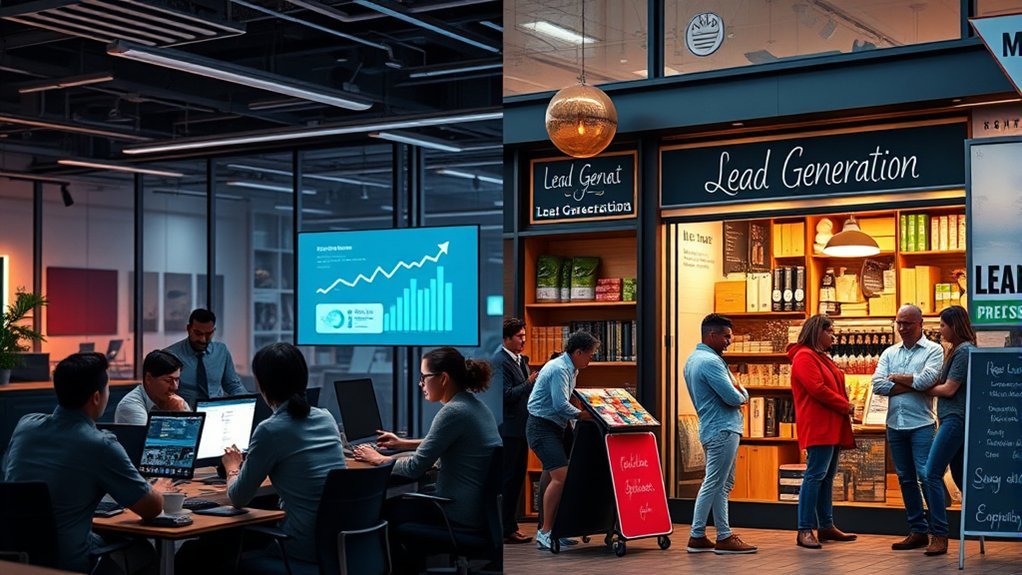
Even with different goals and budgets, teams can plug tactics into a simple matrix to prioritize channels that convert fast and scale smart.
Lead generation strategies should align Budget considerations with Target audience, Channel effectiveness, and Conversion tactics. For low-budget SaaS, content + live chat (25% of new MRR; 50% higher lead-to-opportunity) and industry directories create qualified demand, while partner integrations bring high-affinity traffic. for lead generation strategies for finance sectors, leveraging data-driven insights is crucial to identify and prioritize high-value leads. Additionally, implementing personalized outreach campaigns can significantly enhance engagement and drive better conversion rates. By utilizing advanced analytics and targeted content, businesses can optimize their lead generation processes to meet the unique demands of the finance market.
Low-budget local services win with Google Business Profile, geo-fenced social, community sponsorships, and LSAs’ pay-per-lead simplicity.
- Low Budget: SaaS—content, live chat, directories, integrations. Local—GBP, geo-fencing, LSAs, sponsorships.
- Medium Budget: SaaS—partner ecosystems, personalized support plus content, directories; instant web access post-pay. Local—LSAs (Screened/Guaranteed), quick-response systems, add Google Ads.
- High Budget: SaaS—nationwide Google Ads PPC, live chat enhancements; Local—hyper-targeted geo-messaging for urgency; both—LSAs + Google Ads.
Measure CAC, speed-to-lead, and close rate. Double down where intent is highest and response is fastest.
Frequently Asked Questions
How Should Sales and Marketing Handoffs Differ for Saas Vs Local Services?
They should tailor handoffs: SaaS uses scored MQLs, rich context, Stage 0 opportunities, and feedback loops aligned to lead nurturing and the customer journey. Local services prioritize speed-to-lead, territory routing, strict SLAs, clear qualification, and rapid follow-up accountability.
What CRM Setup Best Supports Each Model’s Lead Lifecycle?
They recommend two CRM setups. For SaaS, automate nurturing, usage-based scoring, chatbot lead tracking, partner referrals, renewals, and customer segmentation. For local services, enable geo-filtered intake, instant booking, pay-per-lead validation, budget caps, repeat tracking, and simple text workflows.
How Do Compliance and Data Privacy Impact Each Approach?
Compliance and data privacy shape each approach through data protection and regulatory requirements. SaaS prioritizes GDPR/HIPAA controls, certifications, consent logs. Local services emphasize TCPA-specific opt-ins, verifiable consent, STOP/HELP workflows. They track audits, automate revocations, and accept higher compliant lead costs for reduced risk.
Which Pricing Strategies Improve Lead-To-Customer Conversion by Segment?
They boost conversions by segment with value based pricing, tiered subscriptions, and discount strategies. SMBs respond to free trials and flat-rate tiers; mid-market prefers usage-based tiers; enterprise converts via anchor pricing, custom quotes, and referral incentives validated by A/B tests.
How Should Attribution Modeling Differ Across Saas and Local Services?
They should tailor models to each Customer journey. For SaaS, use multi-touch and data-driven Attribution metrics (U/W-shaped) prioritizing pipeline. For local services, favor last-touch or time-decay for rapid decisions. Validate via cohort analysis, conversion lag, and assisted-conversion reports.
Conclusion
In the end, the smartest teams match tactics to context. SaaS wins with ICP clarity, multi‑touch nurture, SEO/LinkedIn, and webinars that prove value—then measure CPL, CAC, and payback. Local services convert by ranking on Google Local, stacking reviews, running high‑intent ads, and answering fast—tracking call-through and booked jobs. With AI to cut costs and ABM or GMB to drive intent, they’ll build a channel mix by goal, budget, and timeline—and scale what the data proves.