

A realistic CPL isn’t $10—cheap leads defer costs. Benchmarks show SEO at $31–$55 per lead vs. paid at $180+ (SaaS ~$195; legal ~$132; events $800+). Organic compounds and converts better; paid decays. Bigger companies pay more (mid-market ~$180; enterprise ~$348+). Optimize for cost per opportunity, not raw CPL: qualify early, enforce handoffs, and fund channels with low CPO and high win rates. Target CPL from CAC and conversion rates, or you’ll trade volume for wasted pipeline—and miss the real release.
Key Takeaways
- True lead cost varies by industry and channel; 2025 paid CPL ranges from ~$28 automotive to ~$220 real estate, SaaS averages ~$195 paid, ~$55 organic.
- Cheap leads often convert poorly, lowering close rates (e.g., 40% to 11%) and inflating total cost per sale through wasted rep time and extra touches.
- Optimize for Cost per Opportunity/SQL and win rate, not raw CPL; fund channels with low CPO and strong close rates to protect LTV:CAC.
- Organic and SEO compound and convert better long-term (SEO ~$31–$55 CPL) versus PPC decay and higher CPL (~$181 average).
- Backsolve target CPL from CAC and conversion rates; enforce qualification, data quality, and sales handoff standards to avoid “junk” volume.
CPL Benchmarks by Industry (2025)

Three numbers matter in 2025 CPL benchmarking: paid, organic, and channel-specific spread. Across CPL trends, Industry comparisons show B2B Tech/SaaS paying $195 on average vs. $55 organic, but channel spread overturns assumptions: content syndication ($65–$85) often beats Google Ads ($75–$120) and narrows LinkedIn’s premium ($150–$250 TOFU, $230 targeted).
Financial/Insurance averages $180 paid, $40 organic, yet business insurance spikes to $460 paid and $388 organic—still rational when lifetime value dwarfs cost. In this context, maintaining a healthy LTV:CAC ratio of 3:1 or greater is critical to ensure rising CPLs remain economically viable.
Business insurance bucks the averages: $460 paid, $388 organic—justified when lifetime value dominates.
Healthcare/Medtech sits $60–$300; Google Ads $85–$145, medtech TOFU via events/cold email $75–$125, while biotech pushes to $274 paid, $236 organic due to regulatory targeting.
Professional Services/Legal clusters around Google Ads $80–$130; attorneys top at $131.63; B2B services span $35–$150, with longer cycles nudging averages up.
Other sectors: Real Estate $220 paid/$45 organic; Construction $135/$35 and $280–$227 blended; E-commerce $85/$20; Manufacturing Google Ads $60–$100; Automotive bottoms near $28.
Act on spread, not averages.
What “Cost per Lead” Means: and Why Cheap Leads Fail

What “Cost per Lead” Means: and Why Cheap Leads Fail
Cost per Lead (CPL) isn’t a vanity metric; it’s the price of acquiring one qualified prospect and a direct proxy for budget efficiency. By definition, CPL equals total campaign cost divided by the number of leads in a period, including ad spend, creative, software, and agency fees. A “lead” is a prospect who signals intent—form fill, newsletter opt-in, or resource download. Reducing CPL enhances overall marketing ROI and scalability. Employing highintent demand generation techniques can significantly optimize your marketing efforts and improve lead quality. These techniques focus on understanding customer behavior and intent, ensuring your messages reach those who are most likely to convert. By leveraging data-driven insights, you can create tailored campaigns that resonate with your target audience and ultimately lead to reduced CPL and increased ROI.
Accurate tracking via analytics and CRM is non-negotiable for marketing efficiency.
Here’s the contrarian truth: chasing the lowest CPL destroys lead quality and revenue. Cheap leads often originate from broad, low-intent sources and don’t convert. A $50 CPL is meaningless without context; multiply CPL by lead-to-sale conversion to expose cost per sale.
Then compare that to average order value, margins, and lifetime value. If higher-CPL channels yield fewer but sales-ready leads, they’re cheaper per sale.
Action: segment CPL by channel and campaign, tie it to conversion and revenue, and reallocate budget to sources with the best cost per sale, not the lowest CPL.
Paid vs. Organic CPL: What You Really Pay For

Although paid often looks cheaper on the dashboard, the real bill shows up over time. A sober cost analysis shows organic lead generation compounds while paid decays.
Yes, 2025 paid social averages $65 per lead and Facebook can hit $5.83–$21.98. But PPC at $181 per lead is 5.8x pricier than SEO’s $31, and a $50,000 PPC month yields ~276 leads versus 1,612 from SEO. A $2,000 SEO article producing 50 leads monthly outperforms paid search that needs $21,720 yearly to sustain volume—organic’s marginal cost trends to zero. TikTok’s CPL ranges from $8–$15, while YouTube’s sits at $10–$20, underscoring that platform choice materially shifts the cost per lead.
PPC decays; SEO compounds. $181 vs. $31 CPL. $50k: 276 paid leads, 1,612 organic.
Quality tilts organic too. Organic prospects convert better, arrive pre-sold, and drive higher order values, while paid skews top-funnel with longer nurture.
Industry data confirms it: manufacturing saves 40% going organic ($415 vs. $691), healthcare saves 20% ($320 vs. $401), and financial services still pay less organically ($555 vs. $761).
Action: reallocate budget to compounding assets—SEO, video, thought leadership—then use paid to accelerate only proven winners.
Channel CPL: SEO ($31–$55), Email ($53), Social ($65), Events ($800+)
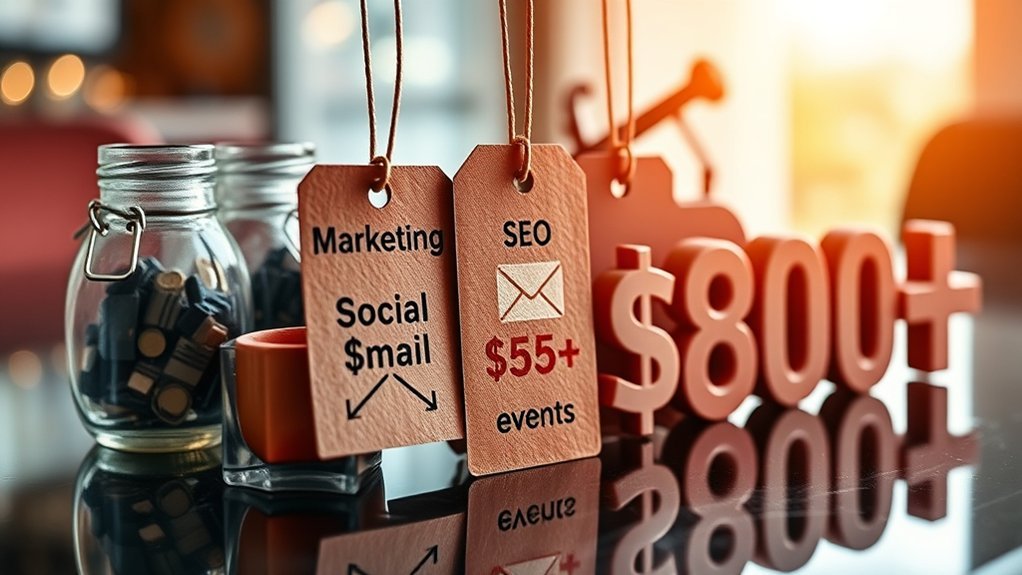
Paid may buy speed, but channel-by-channel math sets the pace: SEO averages $31–$55 CPL, email lands near $53, social sits around $65, and events exceed $800 per lead.
Here’s the contrarian read: don’t chase the cheapest line item—optimize the highest conviction.
With SEO strategies, calculate CPL as spend ÷ SEO-sourced leads, then prioritize conversion-first pages and intent clusters; quality lifts close rates and keeps costs durable. Also, remember that evaluating CPL in isolation is misleading—pair it with conversion rates and customer lifetime value to judge true efficiency.
For Email optimization, the ROI (42:1) justifies list cleaning at $0.006–$0.01 and disciplined segmentation; a $1,000 test yielding 40 leads at $25 CPL isn’t an outlier when cadence and offer match.
Social engagement costs more due to bidding and weak organic reach; make it earn its keep via retargeting from email lists and webinar-driven lead forms, tracked to revenue.
Events demand rigorous Event planning: model venue, travel, staffing, and follow-up, then greenlight only when high-intent deal sizes can amortize $800+ CPL.
Company Size and Revenue: How They Raise CPL

While intuition says bigger teams buy cheaper leads at scale, the data flips that script: CPL climbs with size and revenue.
Small organizations (2–50 employees) average $47–$146 per lead, with scrappy tactics pushing some to $10–$30.
Mid-sized firms see the employee count impact: 51–200 employees average $180, and 201–1,000 average $212.
Enterprises over 1,000 employees hit $348–$349, reflecting complex, multi-channel programs and bigger-client pursuits.
Revenue implications mirror the pattern. Companies under $1M can generate $10–$30 leads but typically average $166.
CPL rises to $179 for $10–$500M firms and jumps to $429 beyond $500M, as strategic partnerships, brand buys, and compliance add cost. In parallel, industry variance means acceptable CPL targets differ widely across sectors, with e-commerce far lower than higher education.
Actionable takeaway: benchmark CPL by cohort.
If headcount is climbing, expect higher paid media mixes, creative/ops overhead, and longer buying cycles.
Preserve small-team efficiency—prioritize channels with measurable intent, constrain martech sprawl, and enforce attribution that gates spend.
Scale what’s working before adding layers.
Set Target CPL With LTV, CAC, and Conversion Rates

Most teams set CPL by gut; the smart move ties it to LTV so revenue per lead and target ROAS cap spend with math, not hope.
They should backsolve from CAC—CAC x close rate = CPQL, then CPQL x qualified rate = CPL—so lead costs align with unit economics.
Finally, they must model funnel conversion rates end-to-end to pressure-test budgets and prevent paying for leads that won’t become revenue.
Tie CPL To LTV
Because lead costs without context are meaningless, set target CPL by backing into it from LTV, CAC goals, and observed conversion rates. The data says “cheap” isn’t efficient—LTV insights, CAC implications, Lead quality, and Conversion strategies must dictate price tolerance.
With a 3:1 LTV:CAC benchmark, a $10,000 LTV and 1-in-10 close rate supports a $100 CPL. High-LTV niches can afford $500 CPL when 1-in-5 converts to a $50,000 deal. He should scale CPL as qualification rises: $50 lead, $125 MQL, $250 SQL at 40–50% pass rates. Investors reward ratios above 3:1 because they fund reinvestment.
- Compute LTV accurately (ARPU × lifetime × margin)
- Set CAC guardrails from LTV
- Map funnel conversion rates
- Price CPL per stage
- Prioritize channels with lower effective CPL (organic vs. paid)
Backsolve From CAC
Instead of guessing a “good” lead price, he should backsolve it from CAC so every dollar maps to customer acquisition efficiency. Start with CAC: total sales and marketing spend divided by new customers in the same period. Then set Target CPL = Target CAC × Lead conversion rate. If LTV is $600, cap CAC at $200 (3:1 LTV:CAC). At 10% Lead conversion, Target CPL becomes $20. That’s CAC optimization in practice—precise, not aspirational.
| Scenario | CAC | Target CPL (with Lead conversion) |
|---|---|---|
| SaaS | $200 | 5% ⇒ $10 |
| Quarterly | $833 | 3% ⇒ $24.99 |
| Example | $40 | 20% ⇒ $8 |
Action steps:
- Recalculate monthly as spend and customer counts shift.
- Include salaries and commissions for true CAC.
- Let higher Lead conversion justify higher CPL; lower conversion demands tighter CPL.
Model Funnel Conversion Rates
While teams debate “good” CPLs, the only defensible number comes from a modeled funnel tied to LTV, CAC, and stage-by-stage conversion.
He starts with funnel stages: visitor-to-lead at 2%–5%, SQL-to-opportunity at 50%–62%, and 15%–30% to closed-won. That math, not gut feel, sets CPL.
If B2B SaaS closes 1.5%–3% overall, a 3x–4x pipeline and a 20% close rate cap what he can pay per lead. High performers push 10%+ with conversion optimization and marketing automation, but average ecommerce sits near 1%–2%.
- Define performance metrics by stage for the target audience
- Price CPL to LTV/CAC, not channel vanity
- Enforce sales alignment on qualification and lead nurturing
- Run testing strategies by channel: email 2.8%–10.3%, paid social 0.9%–2.1%
- Reforecast monthly as rates shift across seasons and segments
Measure Cost per Opportunity, Not Just CPL

Though many teams still obsess over CPL, disciplined marketers shift the primary KPI to Cost per Opportunity (CPO) or Cost per SQL to forecast revenue with precision.
They operationalize opportunity metrics with tight sales alignment, redefining success as qualified pipeline created, not forms captured.
CPL equals spend divided by leads, useful for channel hygiene and pacing. But it ignores intent and over-rewards broad targeting. A $27 Facebook CPL can stuff the funnel while masking quality gaps; a $110 LinkedIn CPL often yields fewer, sales-ready contacts.
That’s why leaders mandate CPO: the cost to create a qualified opportunity. CPO correlates with close rate, making pipeline predictable and CAC/LTV planning defensible.
Action plan:
- Instrument lifecycle stages to distinguish lead, MQL, SQL, Opportunity.
- Report blended CPO and close rate by channel weekly.
- Fund channels with low CPO and high win rate; cut cheap volume that doesn’t convert.
- Set targets using Cost-per-SQL benchmarks to maintain a 3:1 LTV:CAC.
When “Cheap Leads” Kill Your ROI

Marketers chasing low CPL fall into low-quality lead traps: close rates drop from 40% with qualified prospects to 11% with unqualified ones. Sales cycles stretch, and CAC climbs.
The hidden conversion costs show up in wasted rep time, smaller deal sizes, and channels like trade shows hitting $811 CPL while failing to yield decision-makers.
To protect ROI, they should pre-qualify with AI scoring, prioritize inbound and SEO that cut costs 60% while boosting sales-ready volume 50%, and optimize to cost per opportunity—not raw lead volume.
Low-Quality Lead Traps
Even when acquisition costs look attractive, “cheap leads” often sabotage ROI by flooding pipelines with bad data and unqualified prospects. The traps are predictable: fake emails, disconnected numbers, no-answers, and misaligned needs.
Poor data quality alone can erase up to 25% of potential revenue, while roughly 79% of leads never convert without proper lead nurturing. The contrarian fix isn’t “more leads”—it’s tighter lead validation, sharper audience targeting, and relentless campaign monitoring tied to performance metrics and conversion optimization.
- Verify contact fields in real time to protect data quality.
- Track no-answer streaks and short calls to flag sources.
- Score intent via engagement strategies, not just form fills.
- Route and nurture slowly warming leads before sales touches.
- Enforce source-level KPIs and cut underperformers fast.
Hidden Conversion Costs
Tightening validation isn’t just about cleaner pipelines; it exposes why “cheap leads” quietly torpedo ROI.
At $4 each and a 2% conversion rate, cost per conversion hits $200; “expensive” $20 leads at 15% convert for $133.
Layer effort: low-quality leads need 5x more touches, pushing total cost per sale to $1,200 versus $253 when quality assessments gate the funnel.
That drag skews conversion metrics, extending cycles while sales wastes 550 hours and $32,000 per rep yearly.
Marketing compounds losses with nurturing and retargeting to uninterested audiences amid $72B in invalid traffic.
Action: price leads against full-funnel costs.
Enforce validation, suppress outdated records, and monitor fit rates and bounce rates weekly.
Remove sources triggering carrier blocks, TCPA risk, and misalignment between sales and marketing.
Calibrate CPL by Blend: Paid vs. Organic Share and Lead Scores

Although paid can jumpstart volume, calibrating CPL starts by weighting the channel mix to where efficiency actually lives: organic.
Treat channel effectiveness and lead scoring as the control knobs: SEO averages $31 CPL and 2.4–3.2% conversion, versus PPC’s $181 CPL and ~1.3%. That’s 5.8x more leads per dollar from organic, with compounding upside.
- Allocate budget to mirror traffic reality: target 60%+ organic share; resist overfunding PPC’s quick wins.
- Set a blended CPL target tied to lead scoring: pay less for low-score paid leads, more for high-intent organic.
- Use benchmark math: $50k in PPC ≈ 276 leads; the same in SEO ≈ 1,612—price your blended CPL accordingly.
- Weight ROI: organic ~748% vs. paid ~36%; set quarterly mix shifts toward channels proving unit economics.
- Model growth trajectories: Year 1 2,400 SEO leads can exceed 7,200 by Year 3; bake compounding into CPL forecasts.
Calibrate weekly. If paid scales, demand rising lead scores or drop its share.
Optimize for Quality: Tests, Filters, Handoffs
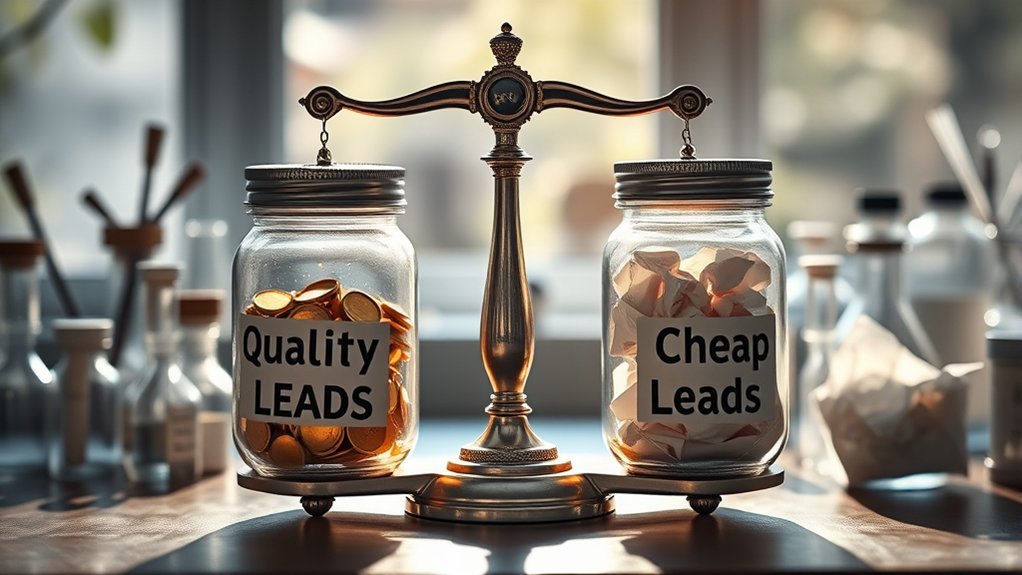
Most teams chase CPL, but pre-qualification scoring and sales-ready handoffs cut waste faster by filtering for intent and fit before a rep ever calls.
He should score leads with behavioral and BANT signals, auto-reject bad data in real time, and route only SQL-likely prospects—lifting CPQL and conversion while lowering volume.
Then he must close the loop with sales feedback and win/loss analysis to recalibrate thresholds weekly, not quarterly.
Pre-Qualification Scoring
Two filters matter before a lead ever hits sales: fit and intent. Pre qualification criteria should reject fast, not nurture forever. Scoring models must weight fit accuracy first—job title, industry, company size, and firmographic signals—then layer engagement depth and conversion readiness. Understanding the qualified lead definition and importance is crucial for optimizing a sales team’s time and resources. When teams clearly define what constitutes a qualified lead, they can focus their efforts on prospects that are more likely to convert, ensuring a more effective sales strategy. This clarity not only improves efficiency but also enhances the overall customer experience, as teams can engage with leads in a more tailored manner.
Only 27% of B2B leads are sales-ready; the rest deserve swift disqualification to protect CAC.
- Use account-based scoring to aggregate signals across target accounts, not lone contacts.
- Apply negative scoring for red flags: personal emails, job-hopping, misaligned solution fit.
- Prioritize engagement velocity and recency over vanity clicks; ignore one-off touches.
- Model timing intent via behavioral sequences and urgency cues, not downloads alone.
- Deploy a dynamic, AI-driven engine with 8–12 weighted factors across fit, interest, and timing.
Track qualification rate and stage-to-stage conversion speed to validate thresholds.
Sales-Ready Handoffs
Scoring without disciplined handoffs just pushes junk faster. Sales-ready handoffs start with explicit sales acceptance criteria, not gut feel.
Define lead readiness with BANT thresholds, then enforce them before any MQL moves. Track Sales Acceptance Rate (SAR) weekly; a low SAR exposes weak marketing alignment or bad targeting.
Diagnose drop-offs: low contact rate = data quality failure; low qualification rate = audience mismatch; low close rate = sales misalignment.
Make opportunity creation rate the gate. If sales won’t open opportunities, the lead wasn’t ready. Tie budgets to win rate by lead source and CPSQL, not CPL.
Some channels close at 10%, others at 1%—price parity hides quality gaps. Monitor lead-to-sale velocity; slow cycles flag low intent. Handoff standards, not volume, protect revenue.
Frequently Asked Questions
How Should Seasonality Influence Monthly CPL Targets and Budgets?
Seasonality should tighten monthly CPL targets when intent spikes and loosen them off-peak. She recommends seasonal adjustments by channel, budget flexibility toward high-conversion windows, scaling back paid search during unfavorable CPAs, and prioritizing organic, retargeting, and historically strong months for ROI.
What Benchmarks Exist for Lead-To-Meeting Booking Rates by Channel?
Benchmarks: cold email reply ~5%, personalized CTAs lift 200%+, multi-channel boosts booking rates 2–4x. Cold calling books ~2–5%. LinkedIn Ads convert 2–4%. Paid search drives over one-third meetings. Prioritize lead quality, engagement strategies, layered marketing funnels for outreach effectiveness.
How Do Data Enrichment Costs Factor Into True CPL Calculations?
They add per-lead costs from enrichment tools to marketing expenses, then adjust CPL by improved conversion. He runs cost analysis by data sources across the lead lifecycle, prioritizing data accuracy, lead quality, and ROI assessment—contrary to ignoring enrichment’s compounding impact.
Which Attribution Model Best Estimates Multi-Touch CPL Accuracy?
Algorithmic multi touch attribution best estimates multi-touch CPL accuracy. It models real lead conversion impact, not opinions. He’d audit data volume, validate lift with holdouts, then pilot time-decay as a pragmatic baseline when data’s thin or politics resist change.
How Often Should We Recalibrate CPL Targets in Fast-Changing Markets?
They should recalibrate weekly. He uses CPL adjustment strategies tied to market trend analysis: trigger changes when CPL deviates 20%, conversion dips below 5-10%, or platform updates hit. He adds event-driven resets and quarterly deep audits for enterprise vs. SMB.
Conclusion
In 2025, smart teams stop chasing bargain CPLs and start buying outcomes. The data’s contrarian truth: cheap leads inflate volume, crush conversion, and bury CAC. Calibrate CPL by channel blend, company size, and lead score, then track cost per opportunity and revenue, not vanity CPL. Pay more for SEO, email, and events when they yield pipeline. Enforce tests, filters, and tight handoffs. If it doesn’t lower cost per opportunity, it’s not “cheap”—it’s expensive noise.