

In high-consideration markets, lead gen shifts from volume to precision. Teams align firmographics with first-party intent, prioritize buying committees, and use LinkedIn, SEO, webinars, and events for reach. AI scoring accelerates velocity, lifting conversions 20–50% and shrinking cycles 20–30%. Benchmarks anchor targets: ~$208 CPL, 2.7% site-to-lead, 20–30% lead-to-MQL. Dynamic personalization, progressive profiling, and compliant enrichment raise quality. An Intent Hub coordinates Email–LinkedIn–Event plays and ranks accounts in real time. The next steps unpack how to execute this.
Key Takeaways
- Optimize for intent over volume: layer firmographics with first-party behavior to prioritize high-intent accounts and exclude low-fit traffic.
- Expand committee coverage: map roles, multi-thread outreach, and deliver 11+ assets across stages before sales engagement.
- Shift content mix: deep guides, calculators, and buyer’s checklists for mid/high intent; lighter awareness for early research.
- Set stage-based goals and CPLs: target ~2.7% site-to-lead, 20–30% lead-to-MQL, and benchmark CPL by channel (e.g., LinkedIn vs. Google).
- Orchestrate AI-driven nurturing: score intent centrally, trigger dynamic emails/retargeting, and respect consent with progressive profiling.
Build a High-Consideration Lead Gen Playbook

Start with a rigorous Ideal Customer Profile and let it govern every move. They define firmographics (size, industry, region), target decision makers by seniority, and anchor criteria in pain points, outcomes, and buying triggers. Align LinkedIn targeting with buyer intent by building audiences from CRM-synced data and exclusions to drive revenue outcomes.
They aim for 70% ICP fit across lead segmentation and buyer personas, then validate with competitive analysis to spot gaps and differentiation.
The content strategy aligns to intent: in-depth guides, resource libraries, and gated research for high-intent; awareness assets for low-intent; interactive calculators and buyer’s guides to capture demand.
Align content to intent: deep guides for high intent, awareness for low, tools to capture demand.
Multichannel outreach blends SEO (driving 34% of qualified B2B leads), LinkedIn (used by 92% of marketers), intent ads, webinars (73% rate best for lead quality), ABM pages, and custom videos.
Engagement metrics inform lead scoring that mixes firmographics, content downloads, and multi-visit signals.
Nurturing tactics use automated emails with case studies and whitepapers to lift trial-to-paid conversions.
Personalization techniques, matched audiences, retargeting, and disciplined CRM routing sustain momentum, while referral programs compound pipeline.
Map the Buyer Journey and Buying Committee Signals
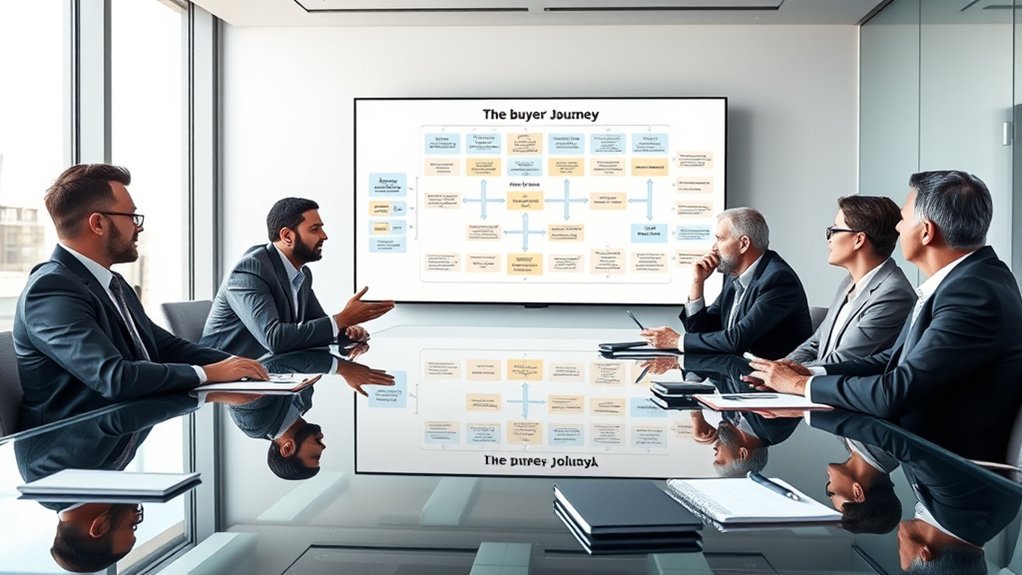
Although high-consideration buying appears linear, effective teams map it as a multi-threaded path defined by intent signals and committee dynamics. They model buyer behavior across 3–15 steps—awareness, consideration, decision—where 67% start with problem queries and 72% research online; 78% begin on Google and prefer articles (80%) to ads.
Consideration intensifies: buyers review roughly 11 content assets and 77–95% read reviews. Integrated engagement across touchpoints—where alignment between websites and sales conversations boosts close rates—significantly improves sales outcomes.
Decision dynamics show 80% contact vendors after 70% of the journey, with 57% reaching this point pre-sales.
Teams profile committee roles—often 6–10 stakeholders—knowing complexity stalls 90% of purchases. While 43% of North American decisions involve ≤2 people, 70% define needs independently and enterprise committees favor familiar brands, with 86% shortlisting known options.
They track engagement signals: time to purchase, touchpoints, conversion rates, expert interactions, and trials. Vendor selection patterns are tight—63% shortlists have 2–3 products, 90% of wins come from the initial set, and 71% keep the top choice.
Use First-Party Intent and Dynamic Enrichment

First‑party intent is the control panel for high-consideration growth: it captures consented signals from owned channels—page views, repeat pricing visits, gated downloads, email engagement, webinars—and ties them to firmographics to surface real buying intent.
These first party insights outperform third-party lists: they’re unique, privacy‑compliant, and align to ICP, cutting unqualified volume. Teams layer behavior with industry, size, and role to rank leads—prioritizing repeat pricing visitors, multiple downloads, and competitor searches. A structured checklist keeps programs aligned and actionable, ensuring intent signals are used promptly by both sales and marketing.
Dynamic enrichment turns signals into action. Systems trigger dynamic personalization across site experiences, email, and ads: show ROI case studies to finance, product guides to engineers, and topic‑matched retargeting based on past consumption.
Lead scoring elevates accounts where CRM‑synced contacts click ads and spend time on relevant pages. The impact is material: intent programs routinely convert 20–25% vs. 5–10% traditionally; 96% of B2B marketers report success; intent‑based ads see 220% higher CTRs.
Responding within one hour to fresh intent accelerates close rates and concentrates effort on the top 10–15% of traffic.
Set Targets With Industry CPL and Conversion Benchmarks

To set credible targets, the team anchors CPL ranges to industry norms—e.g., B2B Tech around $208 per lead, financial services $160+, and LinkedIn Software/IT near $125—then models variance by channel.
They pair this with stage-based conversion goals: site-to-lead near 2.7% overall (1.7% for B2B Tech), lead-to-MQL at 20–30%, and sector-specific lifts like 4.0% in financial services. Aligned sales and marketing teams achieve faster revenue growth, so they synchronize KPIs and improve lead handoff to raise conversion rates.
With these guardrails, they forecast total lead value, prioritize campaigns with superior likelihood-to-revenue, and reallocate budget toward high-yield sources such as webinars.
CPL Ranges By Industry
Three numbers matter when setting CPL targets: industry baseline, channel variance, and conversion assumptions. Leaders anchor to Industry benchmarks, then calibrate for CPL variations by channel and region. All-industry averages land at $198 per lead; blended across channels rises to $391.8. Low-CPL outliers include e-commerce ($91) and HVAC (~$92). High-consideration sectors climb: higher education ($982), financial services ($653), legal ($649). B2B averages $230 for 2026; B2B SaaS trends ~$237, with channel spans of $100–$350. As budgets scale, CPLs typically rise due to channel saturation and marginal audience efficiency declines.
| Segment | Typical CPL | Channel Notes |
|---|---|---|
| All-Industry | $198 | Blended $391.8 |
| B2B SaaS | $237 | Paid avg ~£310 (~$390) |
| Legal | $649 | Google Ads $131.63 |
| Financial Services | $653 | High trust costs |
| Higher Education | $982 | Long cycles |
Channel levers: Google Ads averages $70.11; Facebook $27.66; LinkedIn ranges $15–$350 (NAMER $230; APAC $80; LATAM $60).
Conversion Targets By Stage
While CPL sets the cost ceiling, stage-level conversion targets determine throughput and ROI. Benchmarks anchor expectations: high-consideration landing pages median 6.6% (3.8%–12.3% range), paid search averages 3.2%, and email 2.6%.
Yet intent shifts everything. Physicians hit 11.62% on Google Ads; HVAC urgency peaks at 52%. Set targets by funnel analysis and apply conversion rate optimization to close gaps.
- B2B SaaS: 0.5%–1.5% top, 1.5%–3% mid, 3%+ bottom; lead gen B2B aims 2%–5%, 5%–8%, 8%+.
- Legal/Legaltech: 9.7% initial, 23.1% qualified; Finance: 9.0% initial, 19.4% qualified; Healthcare: 12.3% initial, 21.5% qualified.
- Education: 2%–5% top, 5%–8% mid; Real estate: 1%–3% top, 3%–6% mid.
Channel nuance: organic ~2.7%, referral ~2.9%, regional/mobile skews apply; prioritize desktop for complex journeys.
Choose Channels for High-Consideration Deals: LinkedIn, Webinars, SEO, Events

Given that 80% of B2B leads come from LinkedIn and its social prospecting yields high intent, the team should anchor acquisition there.
They can pair this with webinars—validated by 73% of B2B marketers as top-quality lead sources—and SEO’s low $31 CPL to compound reach and nurture.
This LinkedIn-to-webinar-to-SEO flow balances volume, quality, and cost while accelerating movement from awareness to decision.
LinkedIn As Primary Channel
Because high-consideration deals hinge on precise reach and measurable intent, LinkedIn should anchor the channel mix with formats that convert, not just attract clicks.
Data from LinkedIn Advertising Trends shows Conversation Ads drive 12% CTR and 50% opens, while Message Ads post 3% CTR and 30% opens—outperforming single-image (0.56%) and document ads (0.43%).
Lead gen forms benchmark at 10% completion; anything above signals fit and offer-market resonance. Engagement Metrics Analysis must prioritize form submissions over clicks, validating Ad Format Effectiveness by region: LATAM averages $60 CPL, APAC $80, EMEA $120, NAMER $230.
- Audience Targeting Strategies: layer intent, firmographics, and ABM lists.
- Optimize for form completion, not CTR.
- Sequence Conversation → Sponsored Content.
- Localize bids/creative to regional CPL deltas.
Webinars And SEO Synergy
Even as LinkedIn anchors paid reach, the highest-ROI engine for high-consideration deals is the webinar–SEO flywheel that compounds intent and education.
Data shows 73% of B2B marketers rate webinars best for high-quality leads, with 51-minute average viewing—clear webinar engagement. SEO ranks first for lead-gen ROI in 2025 and drives compounding revenue: $385k in year one, $1.2M year two, $3.3M year three.
The mechanism is tight: SEO optimization captures solution seekers, builds email lists via sign-ups, then webinars nurture with expert sessions, gated assets, and quantitative insights—repurposed from blog data into slides.
Salesforce’s “Dreamforce to You” exemplifies scale. Active blogging generates 67% more leads; content marketing triples volume over outbound.
Combined analytics surface high-intent patterns, streamline education, and raise conversion rates across extended cycles.
Shift From Volume to Velocity With AI Qualification

While many teams still chase sheer lead volume, high-consideration sellers gain more by accelerating velocity with AI qualification. The pivot is measurable: AI Insights elevate Lead Velocity by identifying the right prospects faster, shrinking sales cycles 20–30% and moving leads 23% quicker through stages.
With 67% of lost sales tied to poor qualification, AI’s precision matters—false positive and false negative rates expose where qualification fails, while opportunity conversion tracking proves lift.
- AI-driven scoring boosts conversions 20–50%, with companies reporting 30% higher lead conversions and up to 51% more lead-to-deal wins.
- Prediction accuracy reaches 90%, enabling real-time prioritization that reduces human bias and increases sales-ready throughput by 30–50%.
- Adoption is mainstream: 75% of businesses use or plan AI tools; 98% of sales teams say AI sharpens prioritization.
- Pipeline velocity compounds when qualified leads rise—28–215% increases documented—then progress faster, shortening cycle length by up to 30%.
The result: fewer wasted touches, faster revenue capture, and a reliably higher close rate.
Coordinate Email, LinkedIn, and Events From One Intent Hub

AI-qualified velocity only compounds when outreach hits the right channel at the right moment. An IntentHub centralizes overt and covert signals, unifying contact data, campaigns, and analytics. With Intent Integration, it ranks high-intent accounts, times activation, and coordinates Email Personalization, LinkedIn Targeting, and Event Engagement as one motion. Teams cut waste by suppressing low-intent audiences, focus budgets on surging topics, and attribute revenue from first research touch to closed-won.
The hub triggers emails after lookbook views, adjusts content syndication to research depth, maps decision-makers for multi-thread LinkedIn, and prioritizes event invites for ROI. Real-time alerts on role changes or buying intent compress cycles and raise win rates.
| Motion | Signal-Driven Action | Expected Lift |
|---|---|---|
| Dynamic copy by page behavior | +25% CTR | |
| Topic clusters, persona mapping | +18% lead quality | |
| Events | Invite high-likelihood accounts | +22% meetings set |
| Ads | Programmatic on surge keywords | -15% CAC |
| Analytics | Journey-to-revenue reporting | +30% attribution accuracy |
Build Trust-First Data: Consent, Minimization, Safe Enrichment

Because growth collapses without trust, high-consideration marketers design data capture around explicit consent, minimization, and safe enrichment. They deploy trust building strategies that prove value first, ask little, and honor choices. Compliance regulations affecting lead quality necessitate a rigorous approach to handling consumer data, ensuring transparency and accountability at every stage. Marketers must stay vigilant in adapting their strategies to meet these evolving standards while still fostering genuine connections with their audience. This commitment not only builds trust but also enhances the overall effectiveness of lead generation efforts.
High-value guides, webinars, and case studies earn opt-ins; native, pre-filled forms reduce friction; progressive profiling gathers details over time; and first-party behavioral signals power relevance without third-party crutches—core data compliance measures.
- Use consent-based qualification: score by firmographics and behavior, add negative scores for competitor ties or inactivity, and set explicit MQL handoff thresholds.
- Practice minimization: collect only what’s essential initially, then expand via triggered, context-rich prompts aligned to buying stages.
- Enrich safely with automation that’s preference-aware; orchestrate email, social, retargeting, and interactive video while logging consent and channel choices.
- Build compliant infrastructure: cross-functional data schemas, governed access, A/B-tested messaging, and auditable processes.
Trigger events—job changes, promotions, hiring trends—inform timing, while interactive content converts passive attention into higher-intent signals without breaching consent.
Measure MQL-to-Revenue Impact and Improve Fast

Even before optimizing campaigns, teams quantify how MQLs translate to pipeline and revenue to spot bottlenecks fast. They anchor on MQL metrics that tie to Revenue analysis: MQL-to-SQL rate (SQLs ÷ MQLs), MQL-to-customer, and ROI. Fast tracking uses Impact assessment by source—website 31.3%, referrals 24.7%, webinars 17.8%—and Data segmentation by industry to set Performance benchmarks. Financial Services converts 13% MQL-to-SQL, Fintech 11–19%; enterprise B2B SaaS can hit 40% with alignment. With longer cycles, they track lagged cohorts over ~84 days to avoid false negatives.
| Metric/Lever | Benchmark/Action |
|---|---|
| MQL-to-SQL | Aim 20–30% SaaS; top 40% |
| Source mix | Prioritize website; deprecate email 0.9% |
| SQL-to-won | FS 16%, Fintech 14% |
| ROI | Example: $200k on $40k = 400% |
| Cycle time | Monitor 3-month lag |
Conversion optimization focuses on Lead quality (nurture, qualification), sales-marketing SLAs, and sector strategies (technical content for B2B SaaS). Iterate weekly; escalate channels that raise pipeline-to-revenue yield.
Frequently Asked Questions
How Do We Budget for In-House Versus Outsourced Lead Generation?
They budget by modeling in house costs versus outsourced benefits: compare £1,346 vs £750 per lead, $20–30K vs $6–15K monthly, 3–6 month ramp vs weeks. They pilot a hybrid, stress ROI, scalability, and governance.
What SLAS Should Marketing and Sales Set for Lead Follow-Up Speed?
They set a platinum lead response time: under 1 minute ideal, hard cap 5 minutes. They mandate follow up protocols: multi-channel within 5 minutes, hour-long persistence, same-day cadence, automated alerts, SLA dashboards, and rep/source compliance reviews to prevent qualification collapse.
How Do We Compensate SDRS for Multi-Stakeholder Opportunities?
They compensate SDRs with tiered compensation models tied to performance metrics: SAL quotas, decision-maker involvement, end-user team size, and strategic account bonuses. Add post-quota kickers, team-based bonuses, AE-confirmed meetings, and small revenue share, balancing 60/40 pay splits for longer cycles.
Which Data Retention Period Balances Compliance and Sales Effectiveness?
He recommends purpose-based retention: keep prospect data only while active, then 12–24 months, aligning with GDPR, CCPA geolocation rules, AML five-year exceptions. This balances data compliance and sales strategy, leveraging automated schedules, audit logs, and consent proof to protect conversion velocity.
How Do We Localize Lead Gen for Multilingual, Regulated Markets?
They localize lead gen by tailoring multilingual messaging per region, aligning consent flows to regulatory challenges, prioritizing inbound SEO on compliant content, deploying AI chatbots with audited prompts, leveraging LinkedIn, gated interactive assets, subtitled videos, and omnichannel interpretation—then iteratively optimize via HIPAA/GDPR-safe analytics.
Conclusion
In high-consideration markets, winning lead gen means aligning strategy to data, intent, and velocity. Teams that map buying committees, use first-party signals, and benchmark CPL-to-revenue shift from volume to qualified momentum. They prioritize channels like LinkedIn, webinars, SEO, and events, orchestrated from one intent hub. AI accelerates qualification; trust-first data protects scale. By measuring MQL-to-revenue rigorously and iterating fast, they compress cycles, improve unit economics, and build a predictable pipeline that converts when stakes are highest. Adopting industryspecific lead generation strategies tailored to niche markets can enhance overall effectiveness. These approaches focus not only on attracting potential clients but also on nurturing relationships that drive long-term loyalty. As a result, companies can effectively leverage data-driven insights to further refine their tactics and maximize conversion rates.