

Pay-per-lead typically delivers better near-term ROI thanks to zero fixed fees, £30–£150 per-lead pricing, and 30–50% lower acquisition costs than subscriptions. It fits startups, short campaigns, demo-first motions, and tight budgets—especially with sub-5-minute follow-up. Subscriptions win for multi-threaded enterprise sales, predictable pipeline, and ABM, despite $5k–$12.5k monthly fees and setup costs. Guard ROI with clear SLAs, qualification, and win-rate tracking. Many teams anchor a subscription, then layer PPL for urgency—how to choose depends on your math next.
Key Takeaways
- Pay-per-lead typically delivers 30–50% lower acquisition costs than subscriptions, especially for startups or short-term, demo-first campaigns.
- Subscriptions yield better ROI for complex, enterprise sales by enabling consistent lead flow, ABM enablement, and multi-threaded nurturing.
- ROI hinges on lead quality and SLAs: PPL requires strict qualifications, rapid sub-5-minute follow-up, and held-meeting guarantees.
- Financial risk differs: PPL has variable spend with minimal setup; subscriptions carry fixed monthly fees and potential lock-in.
- Best ROI often blends both: anchor a subscription for steady pipeline, then layer PPL to fill urgent gaps once ideal-fit is confirmed.
The Quick Answer: When Pay-Per-Lead Beats Subscriptions

When fixed fees outpace results, pay-per-lead wins. The pay per lead advantages show up immediately in ROI analysis: zero fixed costs versus £200–£500+ subscriptions and retainers of $3,000–$25,000.
Lead-only pricing at £30–£150 (or $30–$400) with no setup fees drives cost efficiency and 30–50% lower acquisition costs. Subscription drawbacks include high commitments, no guarantees, and harder scaling. In contrast, financial flexibility and risk management improve with variable spend, money-back guarantees, and seasonal throttling aligned to capacity. This shift often delivers 30–50% savings on lead generation costs for contractors.
Marketing performance rises as conversion optimization improves 25–40% after switching, aided by controlled competition (1–5 contractors per lead) and strict SLAs. These lead generation strategies suit short cycles, demo-first motions, and B2C funnels with low CAC.
Businesses can run 30-day pilots to validate economics, then scale spend per appointment ($50–$500) as pipeline needs spike. Result: faster business scalability, predictable per-lead budgeting, and higher opportunity creation without nurturing drag.
Pay-per-lead wins when immediacy and efficiency matter.
Step-by-Step: Choose Pay-Per-Lead or a Subscription

How should a team pick between pay-per-lead and a subscription? Start with business stage and lead sourcing.
Startups and short-term campaigns favor pay-per-lead for low-risk entry and model flexibility; established teams targeting long-term growth lean subscription. Retainers provide predictable costs, aiding budget planning and long-term strategy alignment.
Map sales cycle: short cycles or demo-first motions go pay-per-lead; multi-threaded, complex enterprise deals use subscription to control brand and stakeholders.
Define quality needs. If volume is fine, pay-per-appointment works despite variable qualification. If nurturing matters, choose retainers.
For B2B ROI, CPQL at 1.5–2x CPL can outperform bulk CPL when qualification is decisive.
Run ROI projections. Compare:
- CPL ROI = (Revenue × Close rate) ÷ Total lead cost
- CPA ROI = (Revenue × Show rate × Win rate) ÷ Appointment fee
- Retainer ROI = Revenue ÷ (Monthly Fee + Ad pass-throughs)
A $120 lead at 15% beats a $30 lead at 2%.
Pilot 30 days. Track held-opp%, recycled domains, off-ICP titles, win rate.
Pause losers, scale winners. Consider hybrid: subscription core, PPL top-up.
Pay-Per-Lead vs Subscription Costs: Fees, Rates, Setup

With the model choice framed, teams should quantify the cost mechanics next—fees, rates, and setup.
In a cost comparison, pay-per-lead (PPL) uses variable payment structures: $30–$400 per lead across niches, B2B SaaS averages $310 CPL, and industry rates run ~$650 legal, ~$461 financial services, ~$448 cybersecurity, $237 blended SaaS, $452 fintech. Effective lead generation is crucial for sustaining business growth, so teams should weigh whether they need qualified leads in higher volume or higher quality.
Held meetings commonly price at $500–$1,200, jumping to $1,500–$3,000 for senior enterprise personas. These pricing strategies suit precise lead acquisition and fast tests, but financial implications swing with volume and quality.
Subscriptions emphasize predictability: $5,000–$12,500 monthly is common, $10,000–$20,000+ with ABM, and $2,000–$2,500 can target 8–10 appointments ($200–$300 each).
Subscriptions trade volatility for predictability: $5k–$12.5k monthly, $10k–$20k+ with ABM, or $2k–$2.5k for 8–10 appointments.
Setup differs: PPL often no explicit setup; subscriptions may add $10,000+ project builds; hybrids lower upfront via reduced retainers plus performance.
Service flexibility and risk assessment hinge on pipeline certainty versus variability. Model the payment structures into revenue projections by seniority, geo, and channel mix to benchmark ROI.
Your Downside Risk: Lock-Ins, Guarantees, Refunds

Executives should quantify subscription lock-in risk: automatic renewals cut sign-ups 9–25%, churn rises with cancellation ease, and short-term 21% revenue lifts often net to zero within a year. Research shows that automatic renewals can deter potential subscribers and erode long-term revenue, as consumers anticipate their own inertia. Switching costs—migration, retraining, and data gravity—sustain stickiness yet amplify refund and chargeback exposure when service quality slips.
Subscription Lock-In Risks
Although lock-ins can smooth revenue, they also magnify downside risk: consumer inertia backfires (25% fewer subscribers under auto-renew; 9% fewer long-term sign-ups from automatic enrollment), short-term bumps (+21% revenue) evaporate within a year, and churn compounds as savvy buyers avoid inertia traps.
Subscription fatigue rises as consumer behavior shifts away from perceived manipulation, undermining churn reduction and customer loyalty. Revenue predictability erodes when supply chain shocks and labor shortages cut service reliability, and low cancellation friction accelerates exits.
Inflation squeezes margins while fixed terms block responsive pricing strategies. In B2B, data gravity and switching costs entrench dependence, but reimplementation risk stalls upgrades, exposing contract flexibility gaps. Companies risk operational disruptions due to reliance on a single vendor’s solutions, underscoring the need to plan for vendor lock-in.
High CAC plus failed payments and chargebacks amplify losses, turning “stickiness” into accumulated downside.
Pay-Per-Lead Guarantees
Because pay-per-lead (PPL) promises “no results, no pay,” guarantees and refund clauses can quietly shift downside back to the buyer through definitions of “qualified,” approval windows, and rejection rights.
Pay per lead guarantees often hinge on Approved Lead Rate (ALR). If providers control qualification, low ALR nullifies refunds while click volume stays high. Lead quality assurance should specify verifiable consent, ICP fit, intent signals, and duplicate suppression.
Costs vary wildly—$200–$1,000 for enterprise B2B, $100–$150 in finance/legal affiliates, and $2,000–$3,200 in B2C insurance/education/home services—so guarantee scope must map to LTV and targeted conversion.
Buyers seeking 3:1 ROI should align guarantees to 10–20% of LTV and tiered quality pricing. Require audit rights, transparent ALR reporting, anti-consolidation controls, and refund SLAs tied to documented consent (2025 rules).
Lead Quality in PPL vs Subscriptions: SLAs and Follow-Up

Lead quality hinges on precise SLAs, fast follow-up, and tight qualification handoffs—PPL enforces show rate/held-to-opp while subscriptions commit to quota and ABM enablement.
Teams should set response SLAs (e.g., under 5 minutes), cadence rules, and ICP criteria to prevent paying $500+ for weak meetings and to exploit 2x stakeholder attendance from subscription playbooks.
Align SDR-AE handoff and track ROI with win-rate math (e.g., $120/lead at 15% beats $30/lead at 2%) to reduce disputes and lift opp creation.
SLA Definitions And Enforcement
While both models promise pipeline, their SLAs diverge on what “quality” means and how it’s enforced.
In PPL, SLA metrics codify lead qualification by ICP match, verified role, full contact fields, and intent signals. Contract terms include rejection rights, refunds, and service guarantees tied to outcome measures like 70%+ show rates and 25–40% held-to-opportunity.
Compliance standards use audits, third-party verification, and automated flags for recycled domains. Enforcement strategies resolve disputes within 48 hours and prevent repeat payment on off-ICP leads.
Subscriptions emphasize performance benchmarks around guaranteed monthly volumes, quality tiers, and multi-threading potential.
Providers commit to uptime for lead flow, dashboards, and penalties after 2–3 months of missed conversion thresholds.
Contract terms enable SLA credits, fee reductions, or exits on persistent under-delivery—steady, but less outcome-enforced than PPL.
Follow-Up Speed And Cadence
Even with strong SLAs, follow-up speed and cadence determine ROI: 79% of marketing leads never convert due to poor follow-up. In pay-per-lead, response timing is the lever. Competing with 1–5 contractors per lead demands sub-5‑minute callbacks, tight SMS/email sequences, and same‑day booking to maximize follow up effectiveness. Understanding lead conversion factors is essential for refining these strategies and ensuring that every potential opportunity is maximized. By analyzing data on past leads, businesses can uncover patterns that influence conversion rates, enabling them to tailor their approaches more effectively. Furthermore, implementing a systematic follow-up plan based on these insights can significantly enhance the chances of turning leads into loyal customers.
PPL’s variable lead quality means rapid triage and short-cycle cadences prevent cost bleed from low-intent inquiries.
Subscription models reward disciplined, multi-threaded cadence. With higher-quality, vetted leads and consistent messaging, teams can sustain 7–12 touch sequences over 14–21 days, increasing stakeholder attendance and close rates.
Enablement and account management maintain narrative continuity, lifting conversion even at higher monthly costs. Track cost per appointment, speed-to-first-touch, and win rate; a faster, consistent cadence compounds ROI in both models.
Qualification And Handoff Alignment
Because follow-up only works when the right prospects are in the room, qualification and handoff alignment become the ROI fulcrum.
In PPL, strict SLAs tie payment to qualification criteria, buyer persona mapping, and intent verification. Real-time lead scoring and validation (email/phone) curb fraud; verified decision maker engagement costs more but lifts handoff efficiency.
Tests show 68% show and 32% held-to-opp—strong for pipeline optimization and conversion tracking when sales cycle alignment is clear. Subscriptions trade outcome guarantees for steady motion, using vertical playbooks and executive messaging to double stakeholder attendance, yet quality can drift month to month.
- Define MQL/SQL, geography, and titles to enforce clean handoffs.
- Instrument feedback loops across SDR/AE for rapid refinements.
- Use hybrid: subscription narrative-building, PPL top-ups post-fit confirmation.
Scaling Your Pipeline: How PPL and Subscriptions Flex
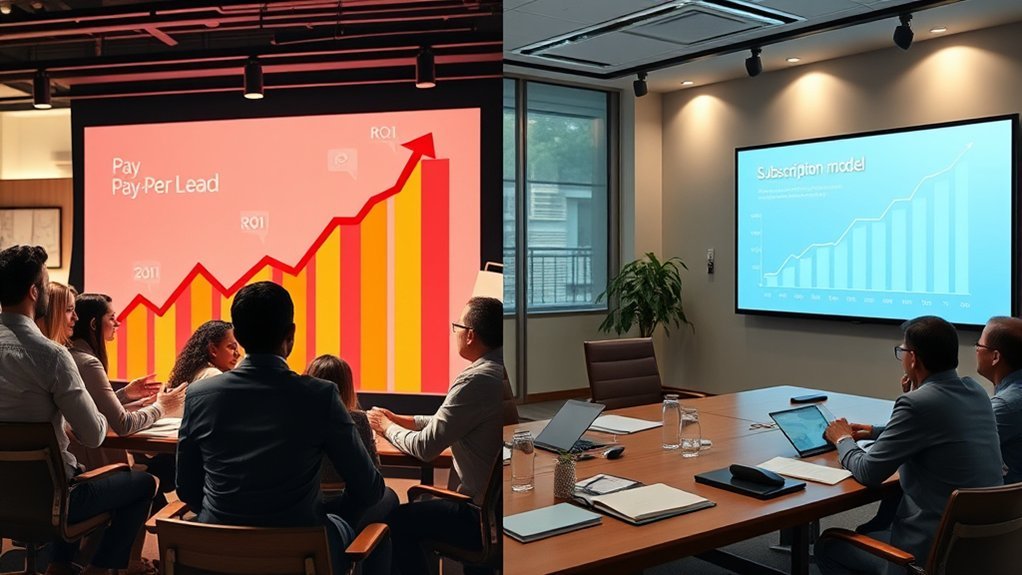
Although both models can fuel growth, they flex differently when pipelines need to move fast. Pay-per-lead (PPL) minimizes scalability challenges when scaling down: teams pause or trim lead orders without contracts, iterate budgets weekly, and exploit fixed per-lead costs ($5–$100+) for precise volume control.
Lead sourcing stays targeted via held-only SLAs and no-show replacements, but quick scale-up depends on partner capacity and quality validation; fake or low-quality leads can stall reliable expansion.
Subscriptions favor rapid scaling up. Monthly or annual access grants unlimited leads, dedicated playbooks, and enablement that widen top-of-funnel reach. The prepaid structure supports long-term capacity planning and steadier pipeline velocity.
Trade-offs: fixed fees persist regardless of lead volume, scale-down requires renegotiation, and narrative onboarding delays ramp.
Best practice: anchor a subscription for consistent flow, then layer PPL for urgent surges or ICP-tight sprints. Use 30-day pilots to test throughput before committing.
ROI Math You Can Copy: Plug In Your Conversion Rates

How fast can a model pay back? Start with conversion metrics. For CPL, ROI = (Revenue × Close rate) ÷ Total lead cost (generation + lead nurturing). A $120 lead at 15% crushes a $30 lead at 2%.
Budget predictability helps, but quality variance can inflate costs if leads aren’t conversion-ready.
For CPQL, expect 1.5–2x CPL pricing. The tradeoff: higher qualification improves show rates and held-to-opportunity, lowering cost per appointment and lifting close rates.
Track definitions to avoid paying for recycled contacts.
Performance-based pricing (CPA) runs ~$150–$200 per conversion. It reduces risk—pay only for wins—but demands tight close-rate and win-rate tracking to cap acceptable cost per conversion.
Retainers ($2k–$25k/month) require dividing revenue by fees plus ad pass-throughs. They often deliver better-qualified leads, shortening nurturing cycles, but fixed costs persist regardless of output.
- Anchor ROI to close rate and CAC payback.
- Benchmark by cohort: CPL vs CPQL vs CPA.
- Monitor leakage: show rate, no-shows, nurture lag.
Best-Fit Use Cases: By Business Model and Sales Cycle
When matching pricing to go-to-market, fit follows sales motion and payback speed. Early-stage business types with short campaign duration and clear customer profiles favor pay-per-lead: $50–$500 per appointment creates financial flexibility, variable spend, and fast pipeline.
Lead prioritization skews to volume; risk management hinges on accepting quality variance for short sales stages.
Mid-market services with $60k ACV and multi-threaded sales stages win on subscriptions. Predictable $3k–$25k monthly spend funds engagement strategies like vertical playbooks and executive-ready messaging, doubling stakeholder attendance and improving lead prioritization and targeting control.
Enterprise SaaS with long cycles needs subscriptions first. Two months to nail narrative, stakeholders, and security processes enables consistent flow and compliance; fixed fees support risk management and high-quality nurturing across complex customer profiles.
High-volume B2C prefers CPL and bulk data under $1 per contact—scalable outreach, simple funnels, and seasonal financial flexibility beat retainers.
Quality-first B2B can justify 1.5–2x CPL for qualified leads when conversion and LTV warrant it.
When a Hybrid Model Wins: Combine PPL With Subscriptions

Teams mapping pricing to sales motion can outperform single-model approaches by combining pay-per-lead with subscriptions. A hybrid structure anchors revenue stability with a modest retainer and adds performance incentives: fee per held meeting, stage-qualified opportunity bonuses, and milestone kickers for multi-stakeholder progress.
It mirrors Salesforce- or Slack-style tiers plus usage add-ons, appealing to broader customer segments while guarding brand control and quality via tight SLAs and filters.
- Predictable baseline: subscriptions fund enablement and operations; usage layers scale with demand, boosting NRR, LTV, and cash-flow consistency.
- Outcome alignment: held-meeting billing prevents charges on no-shows; pay-per-opportunity rewards real pipeline; kickers accelerate advancement in complex sales.
- Flexible throttling: customers modulate volume like PPL without churn risk; agencies sustain capacity regardless of short-term dips.
Track cost per held meeting, held-to-opportunity conversion, time to opportunity, and expansion revenue.
Run 30-day matched pilots. Optimize by ICP data to capture hybrid advantages and faster retention-driven growth.
Frequently Asked Questions
How Do Data Privacy Laws Impact Pay-Per-Lead Providers?
They face stricter consent, higher acquisition costs, and fewer resales. Data compliance drives explicit opt-ins, double opt-in, audits, and retention limits. Lead transparency improves quality and trust, reducing disputes and refunds, boosting ROI via validated intent, cleaner pipelines, and provider differentiation.
What Contract Clauses Protect Against Lead Fraud?
They protect against lead fraud via contract stipulations mandating lead verification, fraud prevention controls, and compliance measures. Clauses include prohibited acts, warranties, reporting/investigation duties, termination/liability remedies, audit rights, secure communications, hotline reporting, and due diligence—driving ROI by deterring, detecting, and recovering fraud losses.
How Should We Attribute Revenue Across Multiple Lead Sources?
They should use multi-touch lead source attribution with revenue distribution strategies aligned to journey complexity: U-shaped for top-funnel, W-shaped for B2B sales involvement, time-decay for long cycles, linear for parity. Integrate CRM, standardize windows, validate ROI via cohort comparisons. Furthermore, measuring lead generation effectiveness requires a comprehensive analysis of each channel’s contribution to conversions. By examining data trends and customer interactions, businesses can identify the most impactful touchpoints. This insight enables organizations to refine their marketing strategies and allocate resources more efficiently.
How Do We Forecast Cash Flow With Variable PPL Spend?
He forecasts cash flow under variable spending by modeling lead volume × CPL, adjusting for show, held→opp%, and win rates. He runs scenario ranges, 30-day pilots, and SLAs, prioritizing high-ROI ICP filters to stabilize variance and protect margins.
What Tech Stack Integrations Reduce Lead Response Time?
They reduce lead response by integrating CRM-MAP bi-directional sync, automated routing, enrichment APIs, and AI-driven replies. These automation tools deliver tech efficiencies, integration benefits, sub-second data flow, SLA compliance, and hour-one engagement, accelerating speed-to-lead and ROI while minimizing manual lag.
Conclusion
In the end, the right model depends on math, risk tolerance, and sales ops discipline. If CAC must stay variable, PPL wins—especially with strict SLAs and refund terms. If LTV is proven, lead volume is steady, and conversion is consistent, subscriptions deliver cheaper, compounding CAC. Operators should model conversion-to-revenue, refund rates, and capacity, then pilot both. Many see best ROI via a hybrid: PPL for spikes and tests, subscription for baseline pipeline at a lower blended CAC.