

AI voice typically converts more high-intent leads than AI chat—15–25% vs. 8–12%—driven by 35–50% connection rates and 75–85% completion. Chat shines on scale and cost, delivering 12.3% vs. 3.1% baseline (4x lift) and handling thousands of concurrent conversations, cutting support costs 40–70%. Voice suits higher-ticket deals with 62% lower cost per qualified lead and 4.7x more qualified leads. Chat wins predictable intents with 95%+ accuracy. A hybrid often yields the best outcomes—here’s how to optimize both together.
Key Takeaways
- AI voice generally converts more leads than chat, delivering 12–15%+ conversion vs chat’s typical 2–3% in many campaigns.
- Voice excels for high-intent, higher-ticket sales, with 45–65% of voice-qualified leads turning into opportunities.
- Chat wins in scale and first-touch triage, achieving 8–12% conversion with strong AI and 20–30% in optimized systems like VIVI.
- Proactive voice callbacks reach 35–50% connection rates and 75–85% completion, uncovering nuances that yield 4.7x more qualified leads.
- Best results come from hybrid flows: chat captures and scores intent, then voice converts at 15–25%, maximizing both scale and close rates.
Which Converts More Leads: AI Voice or AI Chat?

So which channel actually converts more leads—AI voice or AI chat? It depends on where buyers sit in the sales funnel and the interaction complexity. how ai transforms buyer intent by analyzing their behavior and preferences, allowing companies to tailor their approaches more effectively. By leveraging this technology, businesses can engage with customers at the right moment and provide personalized experiences that resonate with their needs. This level of insight not only enhances conversion rates but also fosters long-term loyalty among consumers.
Voice AI’s higher engagement and completion rates, plus stronger emotional connection, make it potent for top-of-funnel capture and mid-funnel lead nurturing. Voice personalization builds trust, lifts CSAT, and improves follow up strategies on outbound calls. AI chatbots resolve tickets faster with a 71% successful resolution rate, which can boost satisfaction and loyalty that supports conversion momentum.
Chat adaptability shines for scalable acquisition: websites with chat see notable conversion lifts, and tech firms report sizeable gains thanks to precise intent recognition and fast resolutions.
Customer preferences and user experience should guide routing. Use chat for rapid answers, low-friction qualification, and cost-effective concurrency. Deploy voice when stakes are higher, context is nuanced, or urgency matters.
Hybrid technology integration often wins: let chat triage, escalate to voice for complex moments, and sync outcomes to CRM. This orchestration aligns with budgets while maximizing conversion across segments and scenarios.
Core Stats: Conversion, Engagement, and Cost Benchmarks
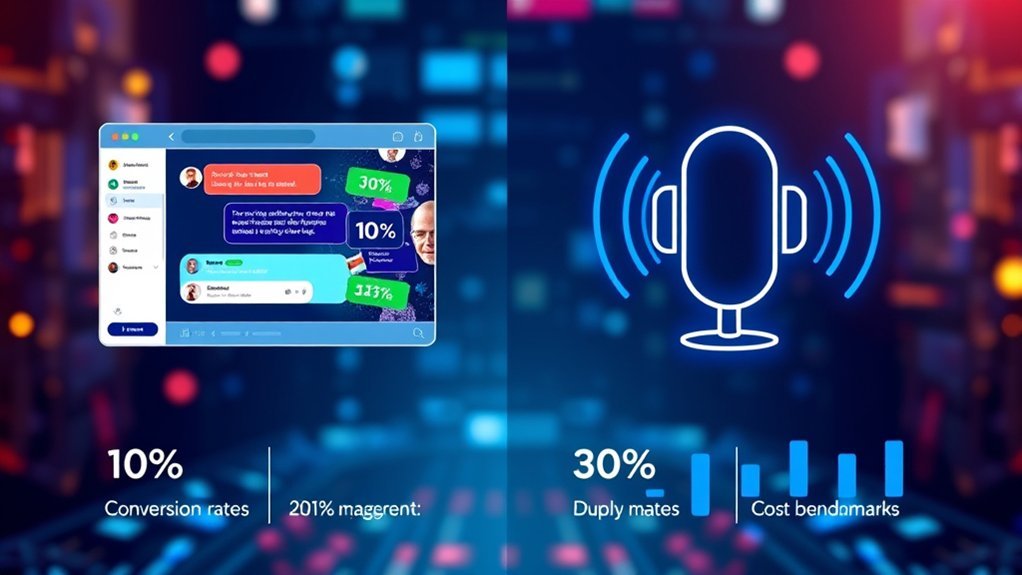
To compare AI chat and AI voice, the team should anchor on hard numbers for conversion and lead quality, engagement and completion rates, and cost and scalability benchmarks. With market consolidation accelerating, teams should consider how shifting user behavior toward mobile engagement influences conversion and channel strategy. Chat shows 4x higher conversion among engagers, 50–80% engagement, and material cost deflection (40–70% fewer tickets). Meanwhile, top performers push 15%+ conversion and 20%+ AOV lifts. They’ll weigh whether voice can match these rates at similar CAC/CPA and handle volume without eroding ROI.
Conversion And Lead Quality
While teams debate AI chat vs AI voice, the conversion and lead-quality math favors chat-first. Across lead engagement and quality metrics, AI chat delivers consistent lifts: ecommerce chats convert at 12.3% vs 3.1% (4X), rule-based bots hit 5–10%, AI sales assistants reach 15–25%, and VIVI reports 20–30%. Proactive chat adds up to 20% more conversions, with 24/7 coverage contributing 20–30% gains. And because VIVI’s generative AI is omnichannel, it also handles voice, WhatsApp, and SMS to ensure seamless coverage and data continuity across every touchpoint.
| Metric | Chat-First Outcome |
|---|---|
| Baseline vs Chat | 3.1% → 12.3% |
| AI Assistant Band | 15–25% |
| VIVI Benchmark | 20–30% |
| First-Time Buyer Share | 64% |
| Faster Response Impact | +22% conversions |
Lead quality improves, too: 55% of teams see better leads, qualification efficiency rises up to 40%, and CRM-personalized scoring sharpens routing. Cost-side wins—30% support savings and 40–70% deflection—recycle budget into higher-intent traffic, compounding conversion and pipeline value.
Engagement And Completion Rates
Engagement is the first fork in the funnel, and completion is the payoff.
AI voice wins early attention: proactive outreach delivers 35–50% connection on callbacks and generates 4.7x more qualified interactions, especially in B2B high-value contexts. Because voice demands full attention, it outperforms passive chat in initial engagement and drives 2.3x better conversion in SaaS. Voice also benefits from callback psychology, which increases commitment and expectations for conversation, further boosting engagement.
Completion follows suit.
Voice conversations complete 75–85% of the time, capture 85–95% of required info, and reach a logical conclusion with fewer drop‑offs—strong completion tactics.
Chat excels at scale with strong engagement strategies: users report 80% positive interactions, 2.3x engagement lift, and up to 35% fewer email tickets.
Completion varies: rule-based chat hits 5–10%, AI assistants 15–25%, VIVI-like bots 20–30%, and up to 70% in sector-specific flows.
Cost And Scalability Benchmarks
Even before creative optimization, the cost-and-scale math favors AI voice for high-intent funnels and AI chat for breadth.
Voice delivers cost efficiency where revenue per interaction matters: ₹1,850 per call with qualified-lead costs near ₹340 and 642% ROI. With 35-50% connections and 45-65% of voice-qualified leads becoming opportunities, pipelines fill faster, and average handle time drops. That lift reduces customer acquisition costs by up to 30%. AI voice dialers can handle significantly more calls per hour than traditional systems, with up to 1000 calls per hour enabling faster pipeline throughput and lower cost per lead.
AI chat wins horizontal scale. AI sales assistants run thousands of concurrent conversations, mitigating scalability challenges that burden phone capacity.
While top chat hits 12-15% conversion (20-30% for specialized assistants), it excels at low-CPL coverage and speed-to-lead.
Pragmatically: use AI voice for high-intent callbacks, revenue-dense follow-ups, and qualification; deploy AI chat to sweep broad traffic and feed voice with warmer, scored prospects.
Why Voice Beats Chat (And When It Doesn’t)

Voice reliably lifts conversions with 4–5x higher engagement, faster lead response (47 seconds vs hours), and superior qualification that cuts cost per qualified lead by 62%.
It wins where immediacy, emotional nuance, and proactive outreach matter—financial services, high-intent sales, and urgent workflows.
Chat still wins on predictable intents and scale, with 95%+ intent accuracy and lower support costs.
Conversion Lift With Voice
Two numbers matter most for conversion lift: speed and certainty. Voice engagement wins by initiating real-time interaction within five minutes, preventing bounces and elevating customer experience.
With proactive outreach, call quality drives 35–50% connection and 75–85% completion, while thorough data capture reaches 85–95%, powering precise lead nurturing.
Conversation dynamics qualify leads better: 45–65% of voice-qualified leads become opportunities, outpacing passive chat.
1) Imagine missed revenue shrinking as immediate callbacks multiply conversions up to 8x—urgency rewarded.
2) Picture sales pipelines thickening as voice turns complex B2B/B2C questions into scheduled demos without extra traffic.
3) Feel budget relief as cost per qualified lead drops—62% lower in real estate, 4.7x more qualified leads in finance, 2.3x higher SaaS conversions.
Voice raises conversion certainty through speed, depth, and decisive outcomes.
When Chat Wins
While voice dominates complex, high-intent moments, chat still wins the first touch and the fastest triage. Chatbot benefits are clearest where speed, scale, and consistency matter: websites, apps, and WhatsApp entry points. Rule-based bots convert 5–10%, single AI 8–12%, and sector leaders push 70%. Conversational AI lifts rates 22% and drives 25% higher outcomes versus traditional strategies. With 95%+ intent accuracy and 92–98% response consistency, chat reduces wait times, cuts support costs by 45%, and deploys in weeks—boosting user experience without heavy lift.
| Use case | KPI impact | Notes |
|---|---|---|
| First-touch triage | Faster routing | Filters to voice for high-value |
| Routine tickets | Cost per issue ↓ | Clear written answers win |
| Self-service FAQs | CSAT ↑ | Always-available guidance |
Deployed well, chat accelerates qualification so voice can close.
When AI Chat Outperforms Voice on ROI
Although voice has clear strengths, AI chat often wins on ROI when the goal is to convert web traffic and streamline self-service. In web-first journeys, chatbot efficiency beats voice limitations: chat nudges drive 20–45% more product-page conversions, add-to-cart lifts hit 15–35%, and cart abandonment drops up to 28%.
Sites using AI chat see 23% higher conversion rates, while 24/7 automation trims support costs and accelerates payback.
AI chat lifts conversions 23% while 24/7 automation slashes support costs and speeds payback
- 1) Relief: Nearly 50% fewer tickets and 18% faster resolutions mean leaner teams, lower costs, and calmer backlogs.
- 2) Momentum: Proactive chat boosts conversions another 15% through real-time education and intent capture.
- 3) Confidence: 71% successful resolutions and 28% higher qualification conversions reduce pipeline waste.
Chat also minimizes friction: every extra form field kills 4–11% of conversions, while conversational capture keeps prospects moving at their pace.
Messaging channels like WhatsApp deliver faster ROI, and automated research and outreach cut manual work by up to 40%.
Lead Quality vs Lead Volume: Pick Your North Star
In this section, the team defines a qualified lead with measurable thresholds—conversion intent, budget fit, timeline, and LQI—so they can benchmark quality vs. quantity.
They weigh volume against precision: quality-first programs post 4–5x higher conversion rates and 28% shorter cycles, while bloated pipelines mask revenue health and inflate CAC.
Channel fit matters—AI Chat can screen at scale and boost efficiency 50%, while AI Voice focuses precision on high-intent prospects and complex B2B motions.
Defining Qualified Lead
Because revenue hinges on working the right prospects, teams should define “qualified lead” with precision and align on quality over volume.
A pragmatic qualification process starts with clear MQL and SQL thresholds. An MQL signals interest through engagements (visits, downloads, webinars) and demands nurturing. An SQL sits further down-funnel: it’s vetted by marketing and sales, exhibits intent (demo requests, purchase inquiries), and meets need, budget, authority, and timing.
Lead scoring operationalizes this by weighting behaviors and firmographics, then triggering handoff rules.
1) Confidence: SQL acceptance commits sales to follow up within 24 hours, preventing pipeline decay.
2) Focus: Unaccepted leads return to nurture, protecting reps’ time and win rates.
3) Accountability: Shared definitions reduce finger-pointing and elevate conversion probability across channels.
Volume vs Precision
With MQL/SQL rigor in place, the next decision is the operating compass: maximize lead volume or optimize for precision.
In a technology comparison, AI chat scales lead generation fast: proactive chat lifts conversions 15%, intelligent chatbots drive 181% more opportunities, and 64% of adopters report more qualified leads. Live chat can push conversion up to 40%, while eCommerce chat hits 10%+.
For precision, AI sales assistants convert 15–25% (premium 20–30%), and predictive scoring boosts close rates from 11% to 40%, improving lead quality 25–30%.
Cost efficiency compounds both paths: AI cuts CAC up to 60% and manual work 40%.
Pragmatically, choose volume when pipeline coverage is thin; bias to precision when sales capacity is tight and CAC discipline matters.
Channel Fit Matters
Though both AI chat and AI voice can win, channel fit decides the North Star: volume or precision. Teams should map customer preferences to channel effectiveness.
In B2B, real-time engagement via chat lifts conversion up to 20% and removes 4–5 minute waits, while proactive greetings stop leakage. Voice excels when deals require depth: AI call management routes, records, and summarizes for instant follow-up and cleaner CRM.
AI sales assistants qualify on the fly, hitting 15–25% conversion and boosting lead quality with predictive scoring by up to 30%. The rise of agentic ai in digital marketing has revolutionized how brands interact with consumers. By leveraging advanced algorithms, businesses can personalize content and deliver targeted advertisements, resulting in higher engagement rates. This shift not only enhances brand loyalty but also drives significant revenue growth as companies adapt to the evolving landscape.
Omnichannel matters: one bot across web, mobile, text, and voice, with live chat preferred by 41%, drives 38% more first-time conversions.
1) Avoid friction or lose urgency.
2) Match intent with response speed.
3) Let data pick the dominant channel.
Engagement and Completion Rates: What They Predict
When engagement and completion go up, pipeline quality follows. Engagement psychology explains why voice’s 12–15% engagement (vs 2–3% chat) and 35–50% callbacks create 4–5x more first touches. Completion strategies matter too: voice completes 75–85% of calls (82% conversation completion) versus chat’s 35%, driving faster resolution and lower AHT. Those mechanics predict outcomes: higher voice engagement yields 4.7x more qualified leads; voice-qualified leads convert 2.3x better. Multi-agent voice converts 34%+ of inquiries, forecasting 40% more leads via speed.
| Emotion | Evidence |
|---|---|
| Confidence | 85–95% of completed voice calls yield full lead data |
| Urgency | Hybrid triage + voice resolves 41% faster |
| Control | Voice cuts cost per qualified lead by 62% |
| Momentum | 35% lift in service bookings from consistent completion |
| Assurance | 4.5/5 CSAT and 35% higher order values in hybrids |
Bottom line: engagement fuels qualified volume; completion locks in data and intent. Together, they forecast superior ROI, especially in outbound and complex B2B/B2C funnels.
Qualification Accuracy and Data Capture: Voice vs Chat

Because qualification determines downstream ROI, the gap between voice and chat is decisive: voice agents convert 45–65% of qualified leads into opportunities, capture complete data on 85–95% of finished calls, and qualify 3x faster through clear, multi-turn dialogue that reads tone and intent.
That human-like conversational flow drives qualification depth and context extraction, translating engagement nuances into precise lead data. In financial services, voice produced 4.7x more qualified leads from the same traffic; a SaaS benchmark showed voice-qualified leads converting at 2.3x the chatbot rate.
Human-like voice uncovers nuance, yielding 4.7x more qualified leads and 2.3x higher conversions than chat.
Chat improves speed over forms and handles 79% of common questions, but predefined paths and text-only inputs cap discovery. It skews toward immediate intent, missing complex needs where customer trust matters most.
1) Missed signal anxiety: teams guess because text omits tone.
2) Data integrity relief: voice confirms, verifies, and reduces drop-offs by 25–40%.
3) Confidence momentum: 75–85% conversation completion sustains intent and fills profiles.
Speed, Cost, and Scale: The Real Tradeoffs
Speed, cost, and scale aren’t theoretical—they decide ROI.
On speed, chatbot innovation wins: instant replies, 95%+ intent recognition, and no audio loops. Voice technology delivers natural interaction design but carries 1–2 second latency and 90–95% intent best-case, so chat edges reliability.
On cost, chatbots deploy in weeks, cut support expenses by 45%, and dominate FAQs, tracking, and self-service. Voice agents cost more per interaction yet slash cost per qualified lead by 62%—strong where phone replaces IVR and deflects calls.
Scale favors matching the customer journey. Chatbots resolve high-volume tickets without adding headcount; performance metrics show predictable throughput.
Voice agents reduce handling time by 18% and, with dialers boosting productivity up to 30%, move complex conversations faster.
Engagement tactics differ: chat converts 15–30% with AI assistants (up to 70% in niches), while voice reports 22–25% lifts over traditional dialers.
Conversion strategies that hybridize—chat for filtering, voice for lead nurturing—maximize market trends and outcomes.
Best-Fit Use Cases by Industry and Deal Size

Three patterns consistently predict where AI chat or voice wins by industry and deal size.
In financial services, voice leads dominate complex B2C sales and higher-ticket use case scenarios: AI voice agents produce 4.7x more qualified leads than chat, cut churn 22%, and qualify at 45–65% accuracy—clear advantages when stakes are high.
For SaaS, industry specifics favor a handoff: chat scores intent on-site, then voice or AI sales assistants convert 15–25%; VIVI with CRM integration reaches 20–30%, yielding 2.3x conversion over chatbot-qualified leads.
Real estate and automotive show similar patterns: multi‑agent voice converts 34%+ vs 8–12% for single chat, slashing cost per qualified lead by 62% in real estate and lifting satisfaction to 8.9/10 at dealerships.
1) Fear: missing 34%+ conversion by sticking with single chat.
2) Relief: 62% lower CPL when voice fits the deal size.
3) Confidence: 95%+ chat reliability for low-ticket, high-volume support in retail, with voice boosting CSAT despite 90–95% accuracy.
The Hybrid Playbook: Combine Voice and Chat for Maximum Conversions
While chat excels at triage and scale, the hybrid playbook wins by routing intent to the right channel at the right moment—delivering 4.5/5 CSAT, 35% higher order values, and 41% faster resolutions.
Hybrid wins: route intent to the right channel for higher CSAT, bigger orders, faster resolutions.
This hybrid strategy uses chatbots to filter low-value queries and voice agents to handle complexity, driving a multi-channel approach aligned to the customer journey. With technology integration and shared logic, conversations maintain context for a seamless shift between chat and voice, creating operational synergy and a stronger user experience.
Data proves it: voice generates 4.7x more qualified leads than chat and converts 2.3x better downstream. Multi-agent systems with voice hit 34%+ conversion versus 8–12% for a single chatbot, while hybrid setups cut cost per qualified lead by 62%.
Voice boosts engagement tactics—35–50% connection rates, 75–85% completion, 85–95% information capture, and 45–65% qualification accuracy—plus 22% churn reduction in financial services. Real-time CRM syncing compounds learning and scale across channels.
Frequently Asked Questions
How Do Privacy Laws Differ for Recording AI Voice Calls Vs Chat Logs?
Privacy laws treat AI voice as interception-focused, while chat logs face retention and discovery risks. Voice demands strict consent requirements under TCPA, CIPA, and Wiretap Act; chats trigger privacy regulations on storage, subpoenas, and litigation discoverability, undermining privilege and user confidentiality.
What Integration Pitfalls Occur With CRM and Telephony for Voice AI?
They encounter CRM integration challenges and telephony compatibility issues: slow legacy APIs, missing webhooks, polling hacks, schema drift, brittle auth, no real-time sync, fragmented data, outdated PBXs, weak middleware, and absent fallbacks—hurting response latency, personalization, resolution rates, and conversions.
How Do Multilingual Accents Impact Voice AI Accuracy and Bias?
Multilingual accents degrade voice AI accuracy and amplify bias. He cites WER spikes for non-primary accents, 42% dialect drops, and 99.7% headline limits. He prioritizes accent recognition, bias mitigation, diverse datasets, Common Voice, real-call tuning, regional benchmarks, and real-time adaptation.
What Staffing Changes Are Needed to Monitor and Coach AI Voice Agents?
They add a cross‑functional implementation team, assign a project lead, and formalize agent training. Supervisors monitor performance metrics, review call data, refine scripts, manage escalations, and coach for tone, accuracy, and compliance, driving continuous optimization and higher conversion.
How Should Success Be A/B Tested Between Voice and Chat Channels?
They A/B test success by defining success metrics and comparing channel performance: connection rate, conversation completion, information capture, qualification accuracy, conversion rate, AHT, CSAT, CPL. They segment by funnel stage, normalize traffic quality, run matched cohorts, and calculate statistical significance.
Conclusion
Bottom line: teams shouldn’t pick a channel—they should pick outcomes. Data shows AI voice wins on speed-to-lead, qualification depth, and show-rate, especially for high-intent, high-ACV deals. Chat often delivers lower CAC, higher throughput, and better self-serve conversion for mid/low ACV. The highest ROI comes from a hybrid: voice for hot leads and complex routes, chat for scale and nurture. Track conversion-to-opportunity, cost per qualified meeting, and cycle time, then allocate budget to the top-performing path.