

Lead gen varies by industry because intent, CPL, and conversion mechanics differ. B2C scales on speed and volume (≈10% landing CVR), while B2B optimizes fewer, higher-value leads (≈2.23% CVR; $84 CPL). Organic search drives cost-efficient quality (≈$31 CPL) versus paid ($110), with SEO supplying ~35% of top leads. As CPL rises, intent signals—pricing visits, demos, competitor research—become decisive, boosting 3–5x conversion when followed up fast. High-CPL sectors (Higher Ed, Legal, Finance) must qualify instantly to win—here’s how.
Key Takeaways
- Lead gen varies by industry on cost and speed: B2C favors volume and rapid responses, while B2B prioritizes qualification, value, and longer cycles.
- Cost per lead differs widely; non-profits and retail are cheaper, while Higher Ed, Legal, and Finance face high CPL, demanding tighter qualification.
- Intent signals convert 3–5x better; quick follow-up on pricing views, demos, and comparisons is crucial in high-stakes, high-CPL markets.
- Channel mix should reflect intent and cost: SEO drives lower CPL and trust, PPC fills high-value gaps, LinkedIn targets precise B2B audiences.
- Shift metrics from CPL to CPQL; track intent activation, opportunity creation, and sales velocity to align budget with sales readiness.
Start Here: What Intent-Driven Lead Gen Actually Means

While many teams still chase broad demographics, intent-driven lead generation zeroes in on accounts actively signaling purchase readiness through real behaviors—keyword searches, pricing-page visits, demo requests, webinar attendance, and buying-committee activity. As these teams refine their strategies, they must also navigate compliance challenges in regulated markets that can significantly impact lead generation efforts. Understanding the nuances of these regulations will empower marketers to tailor their approaches effectively, ensuring that they remain both compliant and competitive. This balance between compliance and engagement is crucial for driving sustainable growth in an increasingly complex landscape.
It interprets intent signals across digital footprints: content consumption patterns, competitor research, technology evaluation, and increased site visits. By reading buyer behavior in real time, teams improve prospect targeting, trigger timely outreach, and accelerate lead engagement. Intent-based leads boost conversion rates and ROI by engaging ready-to-buy prospects. effective lead generation strategies for saas require a deep understanding of customer pain points and aligning solutions to address them directly. By leveraging data analytics and targeted marketing campaigns, businesses can identify high-quality leads who are more likely to convert. This strategic approach not only enhances customer relationships but also drives sustainable growth in a competitive landscape.
Data sources span first-party interactions (website paths, purchase history) and third-party analytics (cookies, media brokers), enriched with firmographic and technographic context.
Performance proves the model: intent-led programs convert 3x higher, cut sales cycles by 40%, and slash acquisition costs by 50%. One tech firm captured $50M from 15 accounts via this approach.
Actionably, teams should: prioritize in-market accounts, align sequences to observed behaviors, and coordinate sales alignment on shared scoring.
The result is conversion optimization through precision timing, personalized messaging, and budget focus on high-propensity segments shaped by market trends.
Map Search Intent to Lead Gen Goals

To map search intent to lead gen goals, the team defines high-intent signals (e.g., repeat pricing visits, demo requests) that convert 3–5x better and require sub-5-minute follow-up. Incorporating lead generation strategies in healthcare can further enhance our ability to identify and engage potential clients. By tailoring our approach to the unique needs of healthcare professionals, we can leverage data-driven insights to optimize our outreach efforts. This will ultimately lead to higher conversion rates and more meaningful connections within the industry.
They align funnel stages to content: informational to blogs/playbooks (awareness), commercial to comparisons/use cases (consideration), transactional to pricing/demo/signup (conversion). Organic results build credibility and authority in the industry, and users trust them more than paid ads.
They prioritize channels with highest yield—local pages (8–15% conversion, 2–3x generic), CTA-rich pages that double conversions, and SEO that supplies 35% of top-scoring leads.
Define High-Intent Signals
Because not all clicks signal readiness, high‑intent signals isolate prospects showing purchase urgency and alignment with lead gen goals. High intent indicators include repeated visits to pricing, product pages, and case studies; 3+ minutes on site; multiple returns in days; and engagement with demos, webinars, whitepapers, ROI calculators, and gated assets.
Verified research on TrustRadius and competitor pages, combined with firmographic and technographic fit, strengthens qualification.
Use AI-driven lead scoring to quantify urgency: platforms like Pathmonk assign percentage intent from behavior and conversion-element engagement; Dealfront tiers hot accounts by signal density; HG Insights enriches CRM with verified account context; Pelago extracts themes via NLP. Focusing on high-intent leads improves conversion rates and reduces wasted efforts.
Layer signals—keywords, content consumption, and cross-channel behavior—to distinguish SQL-level urgency from MQL interest, prioritize outreach, compress cycle time, and expand pipeline quality.
Align Funnel Stages
High-intent scoring only works when it maps to where buyers sit in the funnel. Effective funnel alignment starts by intent mapping across awareness: impressions and reach set visibility baselines; page views and sessions signal early exploration; brand mentions and branded search show interest formation; social engagement captures first interaction.
Segment awareness content by intent relevance. Intent data helps identify accounts entering an active buying cycle, enabling timely outreach with relevant messaging.
In consideration, align keywords to evaluation depth: exact product terms, perceived alternatives, and related exploration. Use CTR and engagement to confirm movement, then watch conversion rate and CPL to judge content efficiency.
Content downloads and page-paths reveal research patterns; segment by job title and buying role to address stakeholder needs.
As intent narrows, route leads when scores spike from form fills and high engagement. Maintain multi-touch follow-ups to time progression.
Prioritize Conversion Channels
While every channel can capture demand, teams should prioritize those that convert intent most efficiently. Use intent mapping to align Audience targeting with Industry benchmarks, then invest where Conversion optimization is provable.
SEO strategies lead: organic search averages 2.7% conversion, delivers 35% of highest-scoring leads, and closes at 14.6%, with Thought Leadership SEO outperforming in B2B. Email effectiveness follows—ranked most effective by 48%, with 2.4–2.8% conversions and superior ROI, vital for Lead nurturing. For paid channels, remember that ABM in B2B can convert at 3.8%, outpacing most alternatives when intent is tightly targeted.
PPC trends show 1.2–1.5% conversions; Google Search Ads drive nearly 70% of paid wins. Social engagement varies: LinkedIn drives 80% of B2B leads, but overall B2B rates lag.
1) Build content impact: interactive assets 2x conversions; anchor with blogs.
2) Prioritize email sign-ups; nurture sequences.
3) Use paid search for high-intent capture; retarget efficiently.
Quick Benchmarks: CPL and Conversion by Industry

Even a quick scan of industry benchmarks shows wide CPL dispersion and meaningful conversion gaps that shape strategy. CPL trends from industry comparisons reveal low-cost leaders—non-profits ($31–$43), retail ($34), and education ($55–$85)—while legal services ($650), real estate ($447–$448), and cybersecurity ($406–$448) sit at the high end.
Mid-tier sectors cluster between $99 and $188, with telecom as an outlier at $45. Channel-wise, SEO ($31–$55) and email ($53) offer strong cost efficiency; social ($58–$65), Google Search ($70–$110), and LinkedIn ads ($75–$110) scale with higher variance.
Conversion benchmarks reinforce the need for precise conversion strategies: LinkedIn landing pages convert at 3–8%, with platform-wide performance at 8–15%. B2B’s average CPL of $84 aligns to a 3:1 LTV:CAC ratio, signaling acceptable ROI evaluation if lead quality holds.
Enterprise multi-channel programs often land near $348 CPL. Intent analysis suggests organic channels typically deliver higher-quality leads, sharpening market insights and budget allocation.
Why Intent Matters More as CPL Rises

Benchmark spreads only tell part of the story; as CPL climbs past $50–$100 on platforms like LinkedIn and Google, intent becomes the leverage point that protects ROI. Rising platform competition and geographic pressure inflate acquisition costs, so volume tactics collapse under stagnant conversion rates. That’s where intent significance outweighs raw CPL—quality, not quantity, moves pipeline and payback.
1) Track real intent signals to cut waste: research behavior, deep content engagement, and digital body language surface high-interest accounts early. The cost implications are clear—fewer, better clicks reduce burn.
2) Shift from CPL to CPQL: sales-ready contacts justify premium CPL because higher close rates compress CAC and align with LTV. MQL/SQL stratification exposes which segments earn their cost.
3) Prioritize and route high-intent leads: tighter focus accelerates cycle times and raises conversion rate multipliers, creating predictable revenue even when top-of-funnel looks expensive. Implementing funnel strategies for diverse sectors enables teams to tailor their approaches based on industry specifics. By analyzing data across different markets, businesses can identify unique pain points and adjust their messaging accordingly. This level of customization ultimately fosters stronger connections with potential clients and enhances overall engagement.
Bottom line: expensive leads with verified intent beat cheap, low-intent volume on ROI every time.
B2B vs B2C: Volume, Velocity, and Lead Value
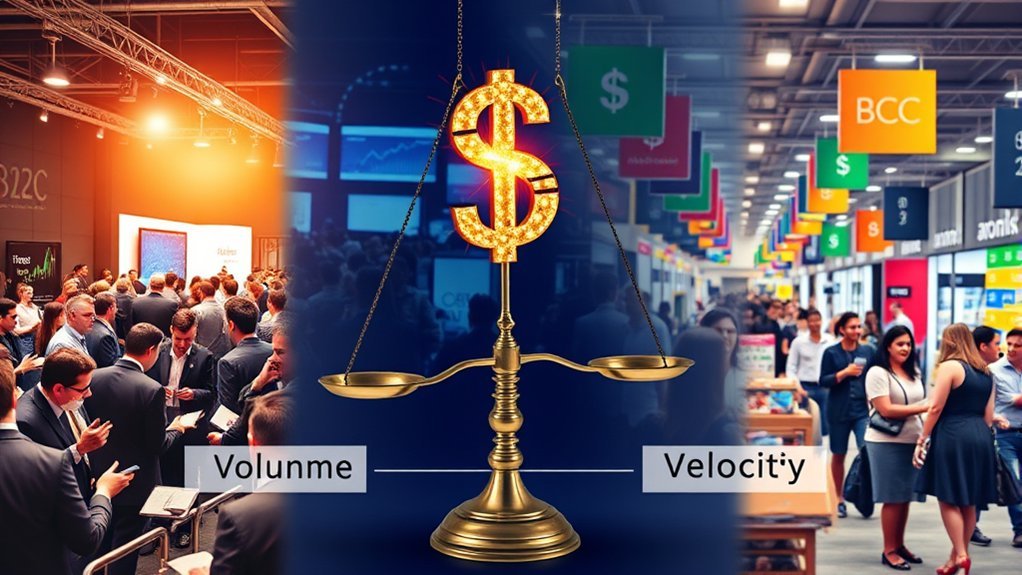
Contrast defines B2B and B2C lead engines: B2C runs on volume and speed; B2B trades scale for value.
Market Comparison shows B2C generated 196.5 new leads in June 2023 versus B2B’s 27, with B2C securing 135 contacts median vs. 54.5.
B2C dwarfs B2B: 196.5 new leads vs. 27; 135 median contacts vs. 54.5
Performance Metrics diverge: B2C landing pages convert near 10% and emails open 20–30% with 3–5% CTR; B2B sites average 2.23% conversion, email CTR 1–3%, and MQL-to-SQL at 16%.
B2C Advantages include CPLs under $50 in retail/ecommerce and easier Lead Generation without offline sources.
B2B Challenges hinge on high Lead Value: average CPL $391.8 (technology ~$208, financial services >$160, healthcare ~$162), offset by SEO closing at 14.6% vs. outbound’s 1.7%.
Conversion Strategies differ: B2C leans into rapid Engagement Techniques and broad Audience Targeting; B2B favors trust-building webinars (2.3% convert; 16% more likely to buy), LinkedIn dominance, and deeper Lead Nurturing aligned to Industry Trends. Additionally, understanding buyer intent analysis in B2B markets allows companies to tailor their messaging and offerings to meet specific needs at each stage of the purchasing journey. By leveraging insights gained from buyer intent data, businesses can enhance their lead scoring models and prioritize interactions that drive conversions. This strategic approach cultivates stronger relationships and ultimately leads to increased sales efficacy.
Choose Channels That Cut CPL Without Killing Intent

To cut CPL without killing intent, they pair low-cost channels with buyer-ready signals: SEO ($31-$55), retargeting ($31), and Google Search (~$70) anchor high-intent, while Meta ($27.66) and Facebook ($5.83-$21.98) add efficient volume.
They balance paid and organic to beat paid-only averages ($310 vs $164 organic), using expert-managed multi-channel to reach ~$134 blended.
They prioritize signal-rich paths—LinkedIn for B2B SaaS ($90-$160), search queries with commercial intent, and multi-step forms—to protect quality while scaling.
Low-CPL, High-Intent Mix
When budgets tighten yet pipeline can’t, a low-CPL, high-intent mix pairs cheap volume with precise re-engagement. Teams blend low cost strategies with nurturing techniques to protect CAC while lifting conversion odds.
1) Start with referrals ($25 CPL) and affiliates ($73 CPL) for scalable awareness. Facebook Ads averages $142 CPL—cheaper than LinkedIn or PPC—delivering segmentable reach that needs structured nurture streams.
2) Layer intent: retarget users who viewed pricing, downloaded gated assets, or spent 3+ minutes on key pages. Trigger ads or SDR notifications at peak interest for higher CVR via timely personalization.
3) Orchestrate multichannel prospecting: email, social, and direct mail average $188 CPL, dropping to $134 with expert management and driving 31% more leads.
Activate intent-data integrations (CRM APIs, technographics) to prioritize in-market accounts and maximize pipeline.
Balance Paid And Organic
Though paid can spike volume fast, the cheapest, highest-intent mix skews organic-first. Data shows clear organic advantages: position‑1 organic earns 39.8% CTR versus 2.1% for paid; SEO averages the lowest CPL at $31 versus SEM’s $110.
That cost efficiency compounds as climbing one organic rank lifts CTR 2.8% on average. For channel balance, allocate higher long‑term weight to SEO (60%) and content while reserving PPC for accelerated tests, high‑value terms, and seasonal gaps—acknowledging paid challenges like rising CPCs and lower lead quality.
Prioritize marketing channels with strategy alignment: organic search and email (CPL $53), supported by webinars ($72) and selective paid LinkedIn ($75).
Track campaign performance by blended CPL and sales-readiness; nurture to cut CPL 33% and lift conversions 50%.
Prioritize Signal-Rich Channels
Because channel cost means nothing without buying intent, prioritize signal-rich sources that lower CPL while preserving readiness to convert. Data shows SEO at $31–$55 and Google Search at ~$70–$110 per lead deliver high-intent queries, while Facebook’s $5.83–$21.98 skews low-intent and requires heavy nurturing.
In B2B, LinkedIn ranges $75–$408, yet precision targeting and multi-step forms filter out noise, protecting pipeline quality.
1) Deploy intent driven strategies on signal rich channels: prioritize SEO, SEM, and LinkedIn where buyers self-identify; use multi-step forms to pre-qualify and curb wasted spend.
2) Match industry economics: SaaS blends organic $164 with paid ~$310; regulated sectors accept $400–$650+ CPL for compliance-grade intent.
3) Reallocate from low-signal impressions: throttle Meta ($27.66 average) to retarget site/search engagers; keep referrals ($25) but verify quality.
When to Go Paid vs. Organic by Industry

While both channels drive pipeline, budget, timeline, and industry dynamics dictate the smarter bet. In B2B, organic strategies on LinkedIn win when budget considerations are tight; paid advertising typically needs $30k+/month to move the needle. Organic builds trust, improving lead quality and conversion rates, while paid accelerates launches or quarter-end gaps.
Manufacturing follows similar industry trends: with CPLs near $691 paid vs. $415 organic, organic strategies and technical content outperform on both cost and lead quality. AI-boosted repurposing further lowers content costs. Use paid advertising only for surge capacity.
Healthcare skews hybrid. Expect ~$401 paid CPL vs. $320 organic; organic wins long-term ROI and lower-funnel conversions, while paid provides quick audience targeting by demographics and immediate volume.
Real estate’s marketing channels are balanced: paid scales listings fast but stops when spend stops; organic networks, databases, and social personas compound.
Prioritize organic for durability, layer paid for new inventory spikes. Align choices to timeline, CPL benchmarks, and audience targeting precision.
Use Intent Signals to Fix Low-Conversion Sectors (Software, Manufacturing)

Paid vs. organic choices set the spend strategy; intent signals fix conversion in stubborn sectors like software and manufacturing. These markets suffer from long cycles and low demo-to-close rates; intent-driven conversion strategies reverse the math.
Marketers layering intent signals on basic fields report 40% conversion jumps, and intent-driven leads convert 3x higher. Platforms using intent reach 20–25% conversion versus 5–10% conventionally, while multi-channel with intent adds another 20% lift.
1) Prioritize buying-stage behavior:
– Track pricing page visits, demo requests, and 3+ minute sessions. Score up competitor research and technology evaluation queries. Firms with new funding move to the top of the queue.
2) Compress the cycle with timing:
– Engage at evaluation—82% of sellers say intent-qualified leads close faster; companies see ~40% shorter cycles. Route SDRs within hours; trigger trials or configurators.
3) Reallocate budget to high-fit, in-market accounts:
– Combine ICP fit with intent to boost lead quality 25–31% and lead-to-opportunity rates to 20–25%. Expect 50% lower CAC and 4x ROI potential; expand volume by up to 90% at 33% lower cost.
Qualify High-CPL Leads Fast (Higher Ed, Legal, Finance)

With CPLs reaching $200–$1,000 in higher ed and similar pressures in legal and finance, teams can’t wait—rapid intent scoring must prioritize the 20% of leads likely to convert.
They should triage high-cost prospects within 5–10 minutes using lead scoring, smart routing, and automated replies, capitalizing on channels showing 8–14% conversion while suppressing low-consent PPL sources.
Action: route LinkedIn and first-party leads to top reps instantly, throttle PPL to nurture tracks, and use triggered re-engagement to salvage the 50% that don’t respond.
Rapid Intent Scoring
Because high-CPL pipelines can’t afford guesswork, Rapid Intent Scoring uses real-time intent data to qualify Higher Ed, Legal, and Finance leads fast. It reads buyer behavior—pricing page revisits, competitor research, webinar attendance, demo requests—and updates scoring models dynamically.
AI integration accelerates lead qualification, boosts sales efficiency, and sharpens market segmentation, driving higher conversion rates in regulated, long-cycle industries. In this context, industryspecific lead generation strategies become essential tools for maximizing outreach and engagement. By tailoring campaigns to the unique needs of different sectors, businesses can enhance their understanding of customer pain points, leading to more effective solutions. This focused approach cultivates stronger relationships and drives sustainable growth over time. Additionally, highconsideration industry lead strategies prioritize personalized communication to resonate with potential clients’ specific challenges. By employing these tailored tactics, organizations can foster deeper insights into market trends and consumer behavior. Such strategic alignment not only improves client retention but also positions businesses as trusted partners in their respective fields.
1) Prioritize fit and timing: Align intent data with ICP criteria; finance and legal require strong signals before routing to sales. Companies using machine learning see 75% higher conversion rates and 40% faster closes.
2) Automate cross-channel triggers: Capture behavior everywhere; AI lifts qualification speed by 60% and quadruples SQOs from 4% to 18%.
3) Iterate models weekly: Replace static demographics with adaptive weights; marketers report 138% ROI with lead scoring and faster intent-based conversions (82%).
Triage High-Cost Prospects
Rapid Intent Scoring sets the stage, but triage decides ROI in high-CPL arenas like Higher Ed ($982 blended CPL), Legal ($649), and Finance ($653).
When CPL rivals tuition payments or retainer fees, high cost strategies hinge on ruthless lead qualification within minutes. Prioritize verified, high-intent inquiries; de-prioritize generic lists and test-service leads that bloat spend and hurt conversion. To optimize your investment, consider implementing robust lead qualification strategies in marketing that focus on data-driven insights. By leveraging advanced analytics, businesses can identify which prospects are most likely to convert, allowing for a more targeted and efficient approach. This not only maximizes ROI but also enhances the overall customer experience by ensuring tailored engagements.
Act fast: 78% enroll with the first responder; delays trigger drop-off. Use a three-step gate: verify identity and program/need fit, confirm urgency and budget (cost is the top barrier), and schedule next action immediately.
Route A-leads to closers; recycle B/C-leads with nurture. Suppress broad, bidding-war keywords; shift budget to channels producing verified intent. This triage preserves margin amid rising CPCs and demographic headwinds.
Build an Intent-Led Funnel for B2B SaaS

Although many funnels chase volume, an intent-led B2B SaaS engine prioritizes qualified momentum: define GTM motion (product-led, sales-led, or hybrid), set S.M.A.R.T goals tied to ARR (e.g., $15M) reverse-engineered from conversion rates and sales velocity, and customize buyer-intent stages from Awareness to Expansion.
Use intent driven strategies and disciplined funnel optimization to align content, qualification, and handoffs with pipeline math.
1) Define the system: Clarify ICP and personas, codify stage gates (Awareness, Interest, Consideration, Decision, Expansion), and specify entry/exit criteria (fit + intent).
Map content: blog and SEO for awareness, gated guides/webinars for interest and consideration, demos/PQL triggers for decision, onboarding and upsell plays for expansion.
2) Instrument measurement: Track lead-to-opportunity conversion, sales velocity, and drop-offs.
Compare to B2B SaaS benchmarks. Attribute channels to pipeline and monitor velocity between stages.
3) Optimize the loop: Run A/B tests on CTAs, forms, and offers.
Tighten routing so only high-fit leads advance. Align sales-marketing definitions and SLAs. Use PQL alerts from product behavior to accelerate decision and inform expansion.
90-Day Intent Plays by Channel (SEO, SEM, Content, Email, LinkedIn)
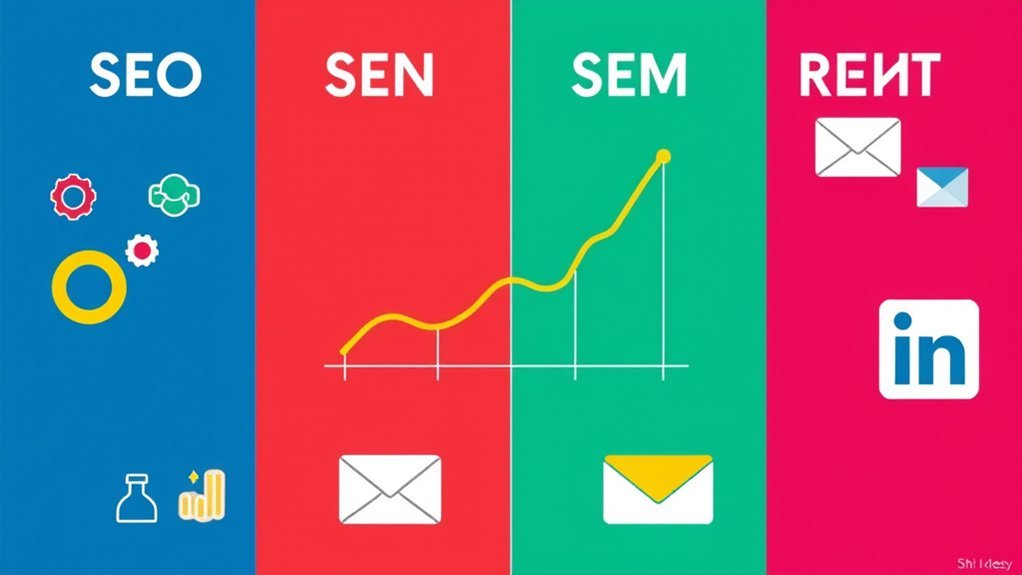
Five channels dominate day-intent capture—SEO, SEM, content, email, and LinkedIn—and each demands a distinct playbook tuned to conversion and cost.
SEO sets the pace: 27% name it top lead source, 41% lead-to-MQL, and $31 CPL—high channel effectiveness for mature lead intent and broad audience targeting.
SEM scales immediacy: 11.9% of leads, 29% conversion, heavy usage at 53.7%; prioritize conversion optimization on high-intent keywords where industry differences inflate CPCs.
Content marketing leads share (51.5%), with 43% calling it top tactic; blogs (used by 89.2%) align content strategy with market trends and retargeting at a $31 CPL.
Email delivers controllable outreach methods: 38% lead-to-MQL, 2.4% baseline conversions, and 6.9% best cold-response; segment engagement strategies by persona and buying stage.
LinkedIn dominates B2B social: 277% more effective than peers, 59% acquire customers, 10% click-to-lead; tighten performance metrics by job title, firmographic filters, and conversation ads to accelerate qualified intent.
Metrics That Prove Intent-Driven Lead Gen Works

When intent data powers lead gen, proof shows up in the numbers. Teams track performance metrics that tie activation to revenue, not vanity. They operationalize high intent targeting, conversion optimization, and sales alignment to tighten funnel efficiency and validate market segmentation choices with data driven insights.
1) Intent activation: Intent Activation Rate shows how often teams act on signals; a higher rate prevents unused data. Sales Engagement Rate for high-intent accounts and Meeting Rate confirm engagement strategies are executed, not theorized.
2) Pipeline conversion: Opportunity Creation Rate and Lead-to-Opportunity Conversion Rate quantify lift from lead scoring. One client saw a 12% higher SQL conversion; 93% of B2B marketers report conversion gains using intent data. Sales Acceptance Rate verifies marketing-to-sales handoffs.
3) Velocity and revenue impact: Track time from surge to first touch, first touch to meeting, and sales cycle length—shorter cycles prove focus. Pipeline sourced by intent, win-rate gains, and revenue influenced confirm ROI. Lead quality rises via buying-group reach, higher replies, and DARTS Score. Understanding how the sales cycle impacts on lead conversion can provide valuable insights for optimizing strategies. By analyzing each stage of the cycle, businesses can identify bottlenecks that hinder effective conversion. This approach not only improves the efficiency of the sales process but also enhances overall revenue generation.
Frequently Asked Questions
How Do Privacy Regulations Impact Intent Data Collection by Industry?
Privacy regulations shape intent data collection by industry via privacy compliance and data transparency demands. Healthcare/finance require opt-in sensitive data, strict profiling limits; SaaS/media rely on contextual signals, GPC honoring. He recommends consented publisher partnerships, ADMT assessments, state-by-state controls, first-party enrichment.
What Tools Best Enrich Intent Data Without Inflating CPL?
Clearbit, ZoomInfo, Apollo.io, and 6sense best enrich intent data without inflating CPL. They deliver intent enrichment, high data quality, CRM integration, and actionable scoring. Prioritize enrichment automation, Slack alerts, dark-funnel insights, and high-intent prioritization to maximize conversions efficiently.
How Should SDR Compensation Align With Intent-Qualified Leads?
Tie SDR pay to intent-qualified outcomes: weight compensation models toward qualified opportunities and pipeline value, not meetings. Use lead scoring thresholds, faster-response bonuses, and revenue accelerators. Reward proposals/close-won influence. Calibrate tiers quarterly using conversion benchmarks to reinforce high-intent focus.
How Do Seasonal Trends Skew Intent Signals in Regulated Sectors?
Seasonal fluctuations skew intent signals as policy updates, holidays, and weather compress evaluation cycles. He prioritizes compliance-driven keywords, monitors on-site spikes, aligns offers to regulatory timelines, and weights macro-indicators. He recalibrates scoring weekly, retargets peaks, and advances content for early researchers.
What SLAS Keep Marketing-To-Sales Handoffs Fast for High-Cpl Leads?
They enforce 8-hour lead response, one-day follow-up on high-priority forms, 48-hour webinar callbacks, and SQL advancement within four days. They automate reassignment if silent, track conversion speed via dashboards, and schedule alignment meetings to sustain accountability and throughput.
Conclusion
In the end, intent clarifies where to invest, how fast to qualify, and which channels to scale. As CPL rises, precision matters more than volume—especially in higher ed, legal, finance, and B2B SaaS. Teams that map search intent to funnel stages, deploy 90-day plays across SEO/SEM/Content/Email/LinkedIn, and instrument metrics (SQL rate, win rate, CAC:LTV, payback) outperform. They cut waste, accelerate velocity, and boost revenue efficiency by aligning offers, messaging, and follow-up to clear buying signals.